
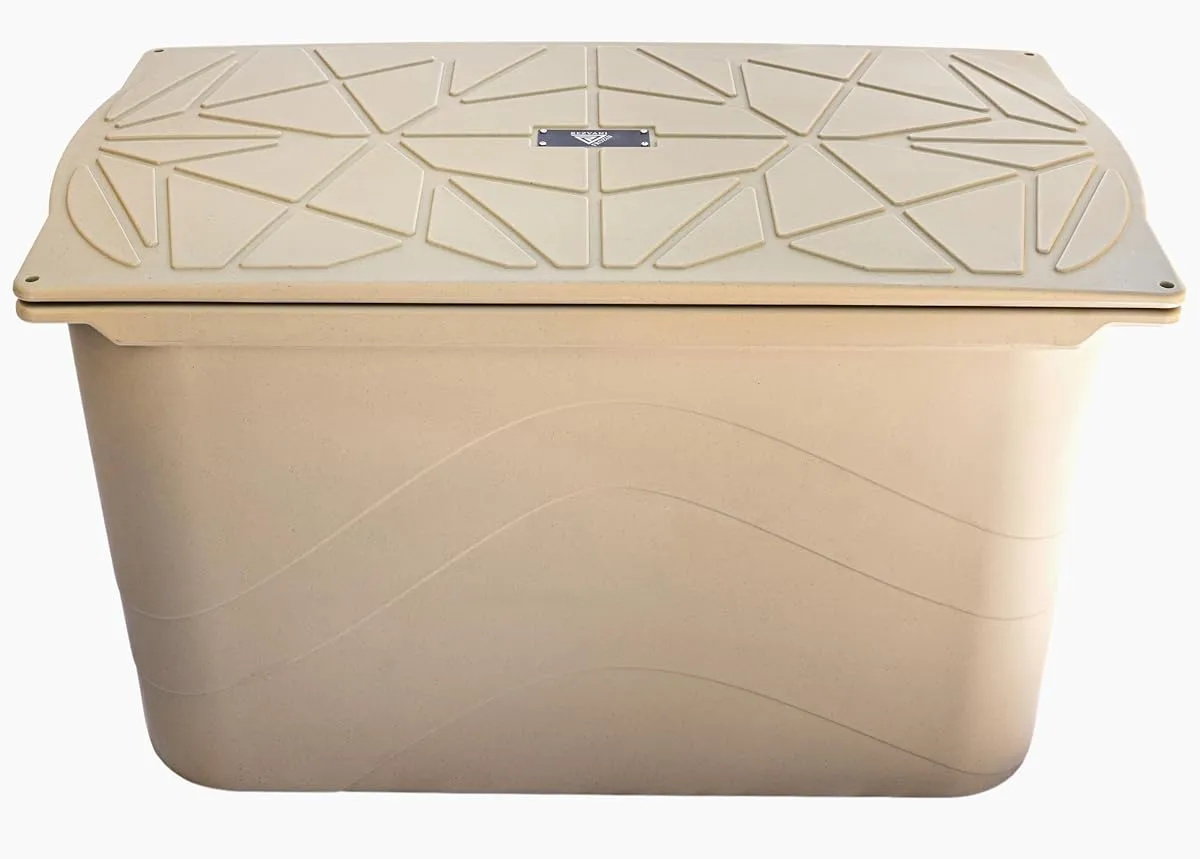
Material decides two things that matter: how long the tub lasts, and whether it can live outdoors. It decides almost nothing about how cold the water gets, which is where most marketing puts the emphasis.
There is also a practical problem specific to this category. Amazon's material fields are frequently wrong, and not subtly wrong. We have found inflatable PVC tubs listed as stainless steel and as cast iron.
This page covers what each material is genuinely good at, and how to spot a listing that is describing something other than the product.
The short version
| Material | Lifespan outdoors | Holds cold | Cost | Best for |
|---|---|---|---|---|
| Rotomoulded polyethylene | Many years | Good when foam insulated | Low to mid | Almost everyone |
| Food safe resin | Many years | Good | Mid | Small footprint rigid tubs |
| Stainless steel | Effectively indefinite | Poor unless insulated | Highest | Looks and permanence |
| Cedar or other wood | Years with maintenance | Moderate | High | Gardens you care about |
| Acrylic | Moderate, better indoors | Moderate | Mid | Indoor or built-in |
| PVC and nylon (soft) | One to two summers | Poor unless layered | Lowest | Trying it, portability |
The important row is the last one, because most tubs sold are soft sided and most buyers do not realise UV is what ends their life.
Rotomoulded polyethylene
The default, and the right answer for most people.
This is the material used for good coolers, kayaks and livestock troughs. It is thick, impact resistant, does not care about frost, and handles years of sun far better than PVC.
Good: durability per dollar is unmatched. It takes knocks. It can be foam insulated during manufacture, which is what actually delivers cold retention.
Bad: it looks like plastic, because it is. And it is not practically repairable: a shell cracked by a hard freeze is finished.
Buy it if you want a permanent outdoor tub and do not need it to be beautiful. Our outdoor tubs page is mostly this material for good reason.
Food safe resin
Close cousin to polyethylene in practice. Used for the rigid vertical tubs, where it moulds into taller shapes with integrated benches and steps.
Good: same weather tolerance, slightly better finish, moulds into more complex forms.
Bad: fewer products, so less owner history. UV ratings are rarely published, which is the one spec that would tell you how it ages.
Stainless steel
The premium option, and the most misunderstood.
Good: it will outlive you. It cleans easily, resists everything, and looks genuinely excellent. Commercial and spa installations use it for those reasons.
Bad: two things. It is the most expensive material by a wide margin. And steel conducts heat well, which is the opposite of what a cold tub wants. An uninsulated steel tub loses cold faster than insulated plastic.
That is not a reason to avoid it. It is a reason to insist on an insulated steel tub, which means a double wall with insulation between. A single skin steel tub is a beautiful object that will cost you a fortune in ice.
Buy it if appearance and permanence justify the price to you, and it is insulated.
Cedar and other wood
The aesthetic choice, and a maintenance relationship.
Good: it looks like furniture rather than equipment. Cedar is naturally rot resistant, which is why it is used for hot tubs and outdoor decking. Wood is a poor conductor, so it holds cold reasonably well without added insulation.
Bad: resistant is not immune. It needs periodic sealing, and a cedar tub ignored for three seasons looks it in a way you cannot reverse with a scrub. Wood also moves with moisture, so joints need to be right.
Buy it if you enjoy maintaining things and the tub sits somewhere you look at often. Do not buy it if sealing a tub sounds like a chore you will resent, because you will.
Acrylic
The bathtub material, and it is fine.
Good: smooth, easy to clean, holds colour, moulds into comfortable shapes. This is why most bathtubs are acrylic.
Bad: more brittle than polyethylene and less tolerant of impact and frost. Better suited to indoor tubs and built-in installations than a freestanding tub in a garden.
PVC and nylon: the soft tubs
Most tubs sold are these, so this section matters most.
Good: cheapest by a wide margin, packs away, light enough to carry. Layered PVC with polyester resists punctures noticeably better than single ply.
Bad: ultraviolet light. This is the thing that ends soft tubs and almost no listing mentions it. Sustained sun makes PVC and nylon brittle, and cracks appear at fold lines and seams. A tub left uncovered on a patio may last one to two summers. The same tub kept covered and shaded lasts considerably longer.
Drop stitch is the upgrade worth knowing about: internal threads hold the walls rigid, the same construction as stiff inflatable paddle boards. It costs more, feels much better to climb into, and lasts longer.
Buy soft if you are finding out whether you will stick with cold plunging, or you genuinely need portability. Keep it covered and out of the sun and it will last far longer than it otherwise would.
Insulation is not a material
This is the confusion the market encourages.
You will see tubs sold on material and tubs sold on insulation, as though they are the same axis. They are not:
- Material determines lifespan and weather tolerance.
- Insulation determines how much ice you buy, forever.
A foam insulated polyethylene tub outperforms a bare stainless steel one at holding cold, while costing a fraction. If you are comparing two tubs and one has insulation, that matters more for your running cost than which plastic or metal the shell is.
How to read a material field on a listing
Because you cannot trust them, here is how we assess them.
Physically impossible claims. An inflatable tub cannot be stainless steel, cast iron, acrylic or aluminium. If it folds into a bag, it is a polymer fabric. We have found all four of those claimed on soft tubs, and we removed them from our own data rather than repeat them.
Vague multi-material lists. “Plastic, Polyester, Polyvinyl Chloride” usually means layered PVC fabric, which is fine and is worth knowing.
Absent entirely. Several tubs publish no material at all. That is the spec that predicts lifespan, so its absence is worth holding against the listing.
The general rule: if one spec on a listing is impossible, distrust the others. A seller who did not check the material field probably did not check the dimensions either, and we have repeatedly found carton dimensions published as tub dimensions on the same listings.
What we would buy
Permanent outdoor tub: foam insulated rotomoulded polyethylene. Best durability per dollar and the insulation is what actually matters.
Small footprint permanent tub: food safe resin, because it moulds into tall shapes with a bench.
Indoors or built in: acrylic is comfortable and easy to clean, and weather tolerance is irrelevant.
Beautiful garden object: cedar, if you will maintain it, or insulated stainless if the budget is there.
Trying it out, or need portability: layered PVC or drop stitch, kept covered and out of the sun.
Common questions
What is the best material for a cold plunge tub?
Rotomoulded polyethylene for almost everyone. It is what good coolers are made from, handles sun and frost for years, takes knocks, and costs far less than stainless or cedar. Insulation matters more than the shell material for performance.
Are stainless steel cold plunge tubs worth it?
They look excellent and last effectively forever, and they are the most expensive option by a wide margin. Steel conducts heat well, so an uninsulated steel tub is worse at holding cold than insulated plastic. Buy it for looks and longevity, not performance.
Do wooden cold plunge tubs rot?
Cedar resists rot rather than being immune to it, and it needs periodic sealing. Neglected for a few seasons it weathers in a way you cannot wash off. It is a maintenance relationship, which some people enjoy and some resent.
Is acrylic good for a cold plunge?
It is fine and it is why most bathtubs are made of it: smooth, easy to clean, holds colour. It is more brittle than polyethylene, so it is better indoors or in a built-in installation than as a freestanding outdoor tub.
Does the material affect how cold the water gets?
Barely. Insulation affects that, and insulation is separate from the shell material. A foam insulated plastic tub holds cold far better than a bare steel one, regardless of which material sounds more premium.
Why do Amazon listings get the material wrong?
Because nobody checks the field. We have found inflatable tubs listed as stainless steel and as cast iron. If a spec on a listing is physically impossible, treat the rest of that listing's specs with caution too.

Written by
Jed Callahan
Editor, Cold Plunge Daddy
I have spent more nights than I want to admit doing math on ice bath listings to find out whether the gallon number is a lie. It usually is. I have been in some of this gear and not all of it, and I always tell you which. I am not a doctor, and I am not going to pretend cold water fixed my life.
- Catching bad spec sheets
- Chiller sizing and power draw
- Warranty and return terms
- What a tub costs to run