
An ice bath chiller replaces bagged ice with a machine. That is the whole proposition, and for anyone plunging more than a few times a week it is the purchase that makes the habit sustainable.
The mistake almost everyone makes is buying on horsepower rather than matching the gallon rating to their tub. An undersized unit runs constantly and still loses. An oversized one wastes money and power.
We compared 12 chillers on capacity, filtration and power draw. We have not run them, and each pick says what we could not confirm, including two listings whose published wattage does not match their stated horsepower.
Three made the page.
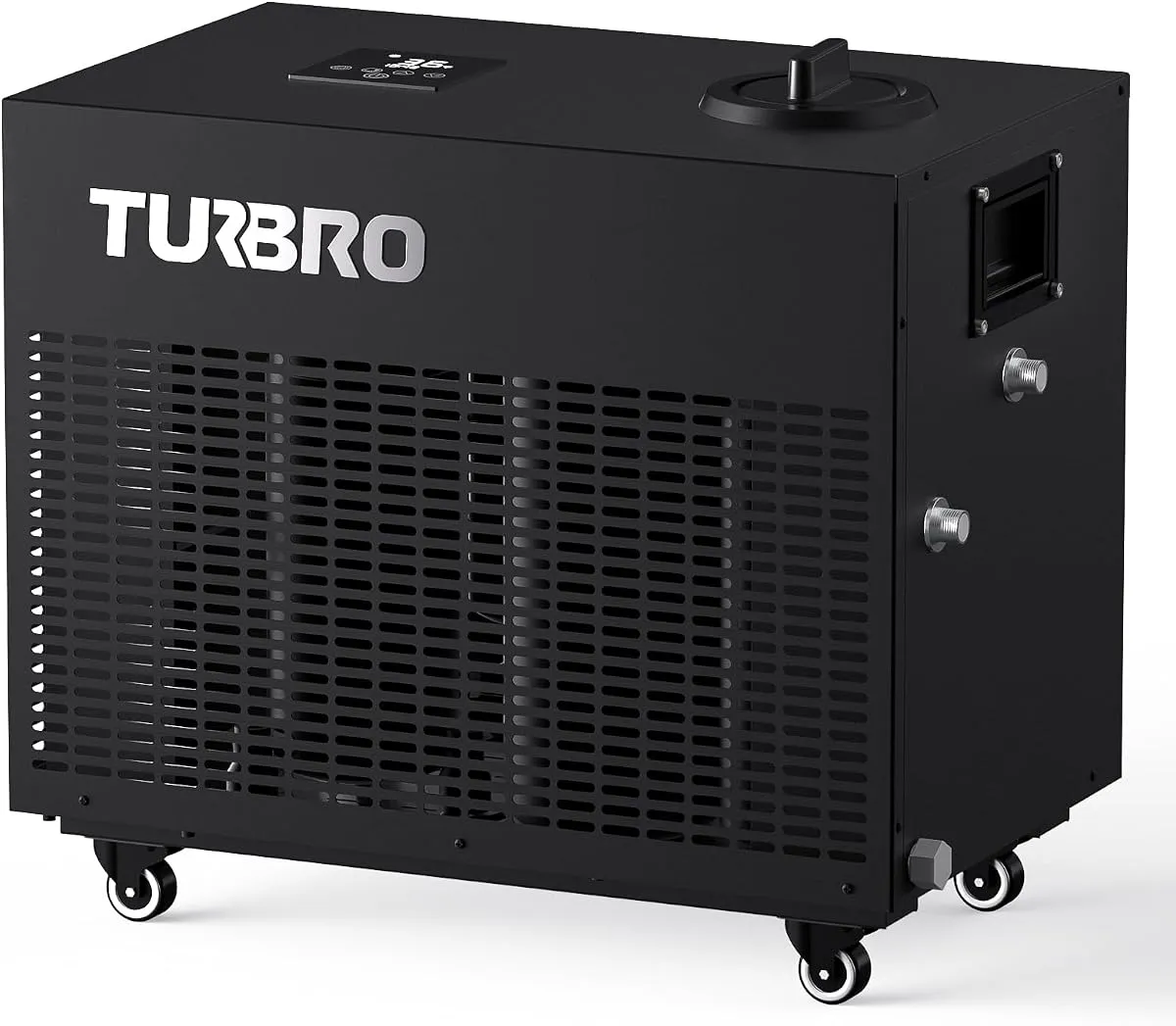
Watch: Best Water Care, the TURBRO 1 HP Cold Plunge Chiller
The short answer
Every pick below wins one job. Find the line that sounds like you, then jump to the full write-up.
-
Best Budget
EONIX 1/3 HP Cold Plunge Chiller
Someone who has decided the ice habit has to stop and wants the lowest possible entry price to make that happen.
Check price on Amazon for EONIX 1/3 HP Cold Plunge Chiller (opens in a new tab) Typically Under $300Read why it won for EONIX 1/3 HP Cold Plunge Chiller -
Best Water Care
TURBRO 1 HP Cold Plunge Chiller
Someone running a tub year round who has decided that draining and refilling every week is the part they want to stop doing.
Check price on Amazon for TURBRO 1 HP Cold Plunge Chiller (opens in a new tab) Typically $800 to $2,000Read why it won for TURBRO 1 HP Cold Plunge Chiller -
Best for Big Tubs
1 HP Cold Plunge Chiller with External Filter
Tubs from roughly 150 to 230 gallons, including the long ovals that anyone over six feet ends up wanting.
Check price on Amazon for 1 HP Cold Plunge Chiller with External Filter (opens in a new tab) Typically $800 to $2,000Read why it won for 1 HP Cold Plunge Chiller with External Filter
Compare them side by side
Same fields for every tub, so you are comparing like with like.
| Product | Award | Best for | Capacity | Material | Power source | Price | Where to buy |
|---|---|---|---|---|---|---|---|
| EONIX 1/3 HP Cold Plunge Chiller | Best Budget | Someone who has decided the ice habit has to stop and wants the lowest possible entry price to make that happen. | 79 gallons | Aluminum | Corded Electric | $ Under $300 | Check price for EONIX 1/3 HP Cold Plunge Chiller (opens in a new tab) |
| TURBRO 1 HP Cold Plunge Chiller | Best Water Care | Someone running a tub year round who has decided that draining and refilling every week is the part they want to stop doing. | 132 gallons | Metal | ac | $$$ $800 to $2,000 | Check price for TURBRO 1 HP Cold Plunge Chiller (opens in a new tab) |
| 1 HP Cold Plunge Chiller with External Filter | Best for Big Tubs | Tubs from roughly 150 to 230 gallons, including the long ovals that anyone over six feet ends up wanting. | 230 gallons | Metal | Corded Electric | $$$ $800 to $2,000 | Check price for 1 HP Cold Plunge Chiller with External Filter (opens in a new tab) |
The full reviews
Best Budget
EONIX 1/3 HP Cold Plunge Chiller
EONIX guanjie-10
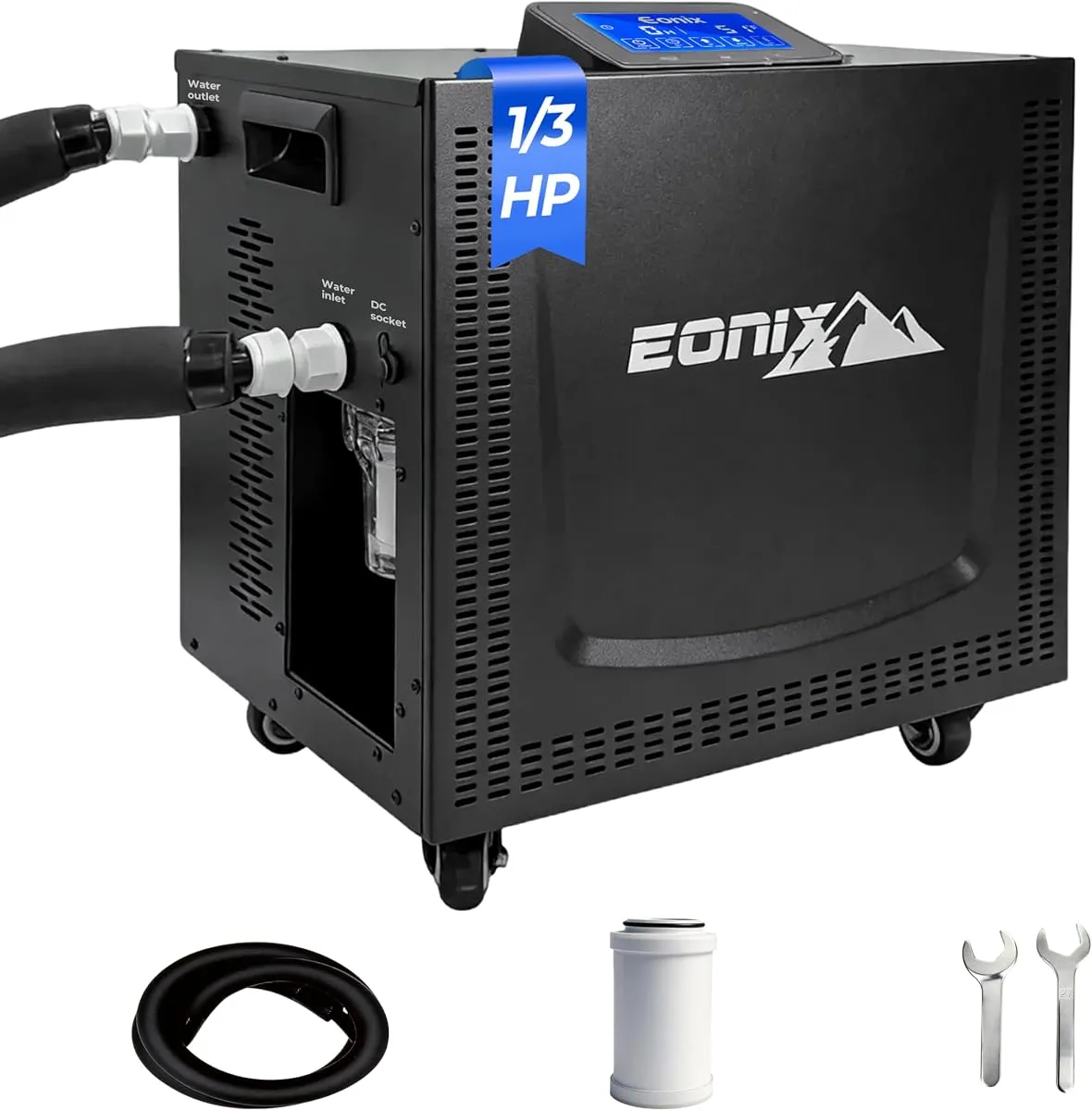
The cheapest chiller here that is rated for a real tub. 1/3 HP on 79 gallons, aluminium heat exchanger, and almost none of the extras the pricier units include.
What we like
- Cheapest way off bagged ice entirely, by a clear margin
- 79 gallon rating matches the most common home tub size
- Aluminium exchanger transfers heat well for the price
- Runs on an ordinary household circuit with no electrical work
What we do not
- Thin owner review base, so long term reliability is genuinely unknown
- Mixed early reviews compared with the better established units
- No ozone or UV, so water treatment is entirely manual
Key specs
- Capacity
- 79 gallons
- Material
- Aluminum
- Power source
- Corded Electric
- Price range
- Under $300
If your only goal is to stop buying ice for the least money possible, this is where that starts.
The right size for the wrong money
1/3 HP rated at 79 gallons is the sensible pairing for a standard home tub. This unit has that rating at a price well below the established names.
Aluminium heat exchangers transfer heat efficiently, which is a reasonable engineering choice at this price rather than a corner cut.
What you are actually risking
Not performance. Reliability.
A cold plunge chiller runs for hours every day. Compressor quality, refrigerant charge and build tolerances determine whether it lasts three years or eight months, and none of those appear on a spec sheet.
The established units on this page have enough owners for a pattern to emerge. This one does not, and the early ratings are mixed rather than clearly good. That is not a verdict, it is an absence of information, and at this price you are accepting that.
The arithmetic still works
Even if this unit lasted only two years, it would likely cost less than two years of bagged ice at four sessions a week. That is the honest case for buying it.
If it lasts five, it is comfortably the best value on this page.
What you do not get
No ozone, no UV, no published wattage. Water treatment is entirely on you, which means a sanitiser and a schedule.
Budget for that alongside the unit, and remember that the lid on your tub does more for cooling efficiency than any difference between chillers at this size.
Buy it if Someone who has decided the ice habit has to stop and wants the lowest possible entry price to make that happen.
Skip it if You want a unit with a proven track record, because this one does not have enough history to have one yet.
The catch The review base is small and the early ratings are mixed rather than good. On a compressor that runs for hours daily, long term reliability is the spec that matters most, and it is the one nobody can tell you about this unit yet.
Not tested by us. Specs checked July 25, 2026. How we research
Best Water Care
TURBRO 1 HP Cold Plunge Chiller
TURBRO FrostCore F85
A full horsepower with ozone and dual filters, rated for 132 gallons. The unit that reduces how often you drain the tub, which is the chore that actually stops people.
What we like
- Ozone filtration meaningfully lengthens the interval between water changes
- Dual filters catch more debris than the single cartridge on cheaper units
- 1 HP on 132 gallons is a genuinely comfortable pairing, not an optimistic one
- Scheduling means it holds temperature only when you need it
What we do not
- Ozone generator cells wear out and are a recurring replacement cost
- Costs several times a basic 1/3 HP unit
- 1 HP draws a large startup surge that a shared outdoor circuit may not like
Key specs
- Capacity
- 132 gallons
- Material
- Metal
- Power source
- ac
- Price range
- $800 to $2,000
Cooling water is the easy part. Keeping it clean is what makes people quietly stop using their ice bath.
The chore nobody warns you about
A tub with a basic filter still needs draining and refilling, and the interval is shorter than you expect once bodies are getting in it regularly.
That means 100 to 200 gallons down the drain, a long refill, and a tub out of action while it comes back down to temperature. Do that weekly and it becomes the reason you skip sessions.
Ozone attacks the problem directly by oxidising contaminants continuously, so water stays usable far longer between full changes.
What ozone does not do
It does not eliminate water care. You will still test, still dose occasionally, and still change the water eventually. It lengthens the interval, which is worth real money in time and water, but it is not a set and forget system.
The cell is a consumable
This is the drawback that matters and it is almost never mentioned upfront.
Ozone generator cells degrade with use. When one stops producing, the machine is a chiller with two filters, and your water care reverts to manual until you replace it.
Find out the cell cost and expected interval before you buy. If the seller cannot tell you, treat that as information about the seller.
Sizing and power
1 HP against 132 gallons is comfortable rather than stretched, which is unusual on this page. It will hold temperature in warm weather and pull down a warm fill in hours rather than overnight.
The cost is electrical. A full horsepower compressor draws a substantial surge on startup, well above its running load, and that surge is what trips breakers. Find out what shares the circuit before delivery.
Who this is really for
If you have a standard 85 gallon tub and plunge four times a week, this is too much machine. Buy a 1/3 HP unit and a bottle of sanitiser.
If you run a large tub year round and have already grown tired of the refill cycle, this is the machine that fixes your actual problem rather than a problem you do not have.
Buy it if Someone running a tub year round who has decided that draining and refilling every week is the part they want to stop doing.
Skip it if You have a standard sized tub and are happy dosing a sanitiser by hand, because the ozone system is most of what you are paying for.
The catch Ozone generator cells degrade with use and need replacing, measured in months of runtime rather than years. That recurring cost never appears at the point of sale, and a dead cell leaves you back on manual dosing with a machine you bought to avoid it.
Not tested by us. Specs checked July 25, 2026. How we research
Best for Big Tubs
1 HP Cold Plunge Chiller with External Filter
PlungeFit FIT1000
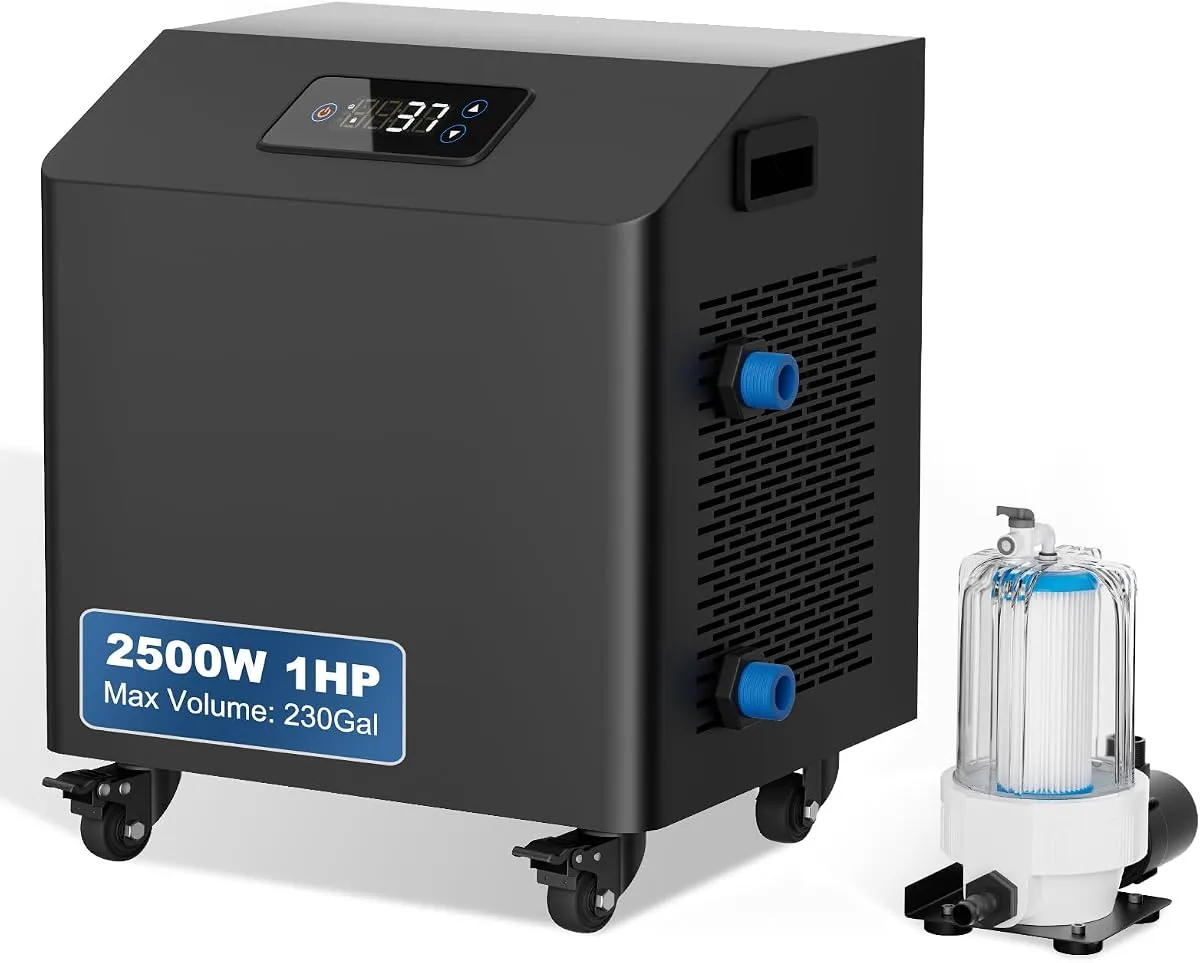
Rated to 230 gallons, which is genuinely the largest capacity here. The external filter is the detail that matters, because you can service it without draining the tub.
What we like
- 230 gallon rating covers oversized and two person tubs that smaller units cannot
- External filter housing means cartridge changes without touching the tub
- High wattage means real pull down speed on a large volume
- Handles the long oval tubs tall users need, where 1/3 HP units fail
What we do not
- Substantial sustained power draw that likely wants its own circuit
- Far more cooling than a standard 85 gallon tub will ever need
- No ozone or UV, so water treatment is still manual despite the filtration
Key specs
- Capacity
- 230 gallons
- Material
- Metal
- Wattage
- 2500 watts
- Power source
- Corded Electric
- Price range
- $800 to $2,000
There is a size cliff in chillers. Below 100 gallons the options are plentiful and cheap. Above 150 they narrow fast. This sits at the top of that range.
When you actually need 230 gallons of capacity
You need it when your tub is large, and tubs get large for one reason: height.
Anyone over six feet needs length, and tubs with length hold 130 to 220 gallons. At that volume a 1/3 HP unit rated for 79 gallons is not slightly undersized, it is the wrong machine. It runs continuously, never reaches your set point on a warm day, and wears itself out doing it.
The external filter is a real convenience
Most chillers put the filter inside the housing. Changing it means shutting the system down and often draining part of the loop.
An external filter housing means you isolate it, swap the cartridge, and carry on. On a system you run continuously, that is the difference between a five minute job and an afternoon.
The wattage question
The listing says 2500 watts. That is high for a nominal 1 HP unit, where you would typically expect something closer to 1000 to 1500.
One of those numbers is wrong and we could not determine which from published information. It matters, because at 2500W sustained you are into dedicated circuit territory rather than plugging into an existing outdoor socket.
Read the rating plate on the actual unit before you plan any electrical work. Do not plan around the listing.
Do not over buy
The flip side is straightforward. If your tub is a standard 85 gallon inflatable, this is the wrong end of the range entirely. You would pay more upfront, draw more power continuously, and gain nothing, because your limiting factor is the tub’s insulation rather than the chiller’s capacity.
Size the chiller to the tub you own, not the tub you might buy.
Buy it if Tubs from roughly 150 to 230 gallons, including the long ovals that anyone over six feet ends up wanting.
Skip it if Your tub is a standard 85 to 100 gallons, because you would pay for and power capacity you never use.
The catch The listing states 2500 watts, which is high even for a full horsepower unit. Either the figure is wrong or this draws considerably more than comparable chillers. Check the rating plate before planning any wiring, because on that number this is close to a dedicated circuit.
Not tested by us. Specs checked July 25, 2026. How we research
How we compared these chillers
Twelve units, then four tests.
Gallon rating against real tub sizes. Not against each other. A chiller is only good or bad relative to the volume it has to cool.
Filtration. Debris only, or ozone and UV as well. That difference decides how often you drain the tub, which is the chore that actually causes people to stop.
Power draw. Two listings on this page publish a wattage that does not match their stated horsepower. We said so in the reviews rather than pick the more flattering number.
Is there enough owner history to judge reliability? On a compressor running hours daily, this matters more than any published spec, and on the cheapest units the honest answer is no.
Sizing, which is the only section that really matters
Nearly every unhappy chiller owner made a sizing mistake rather than a brand mistake.
| Your tub | Start with |
|---|---|
| Under 60 gallons | 1/10 to 1/4 HP |
| 80 to 100 gallons | 1/3 HP |
| 100 to 150 gallons | 1/2 HP |
| 150 gallons and up | 1 HP or more |
Then apply a reality discount. Manufacturer ratings assume a covered, insulated tub in mild air temperature. A bare tub in afternoon sun behaves like a much larger one.
And before you upsize the chiller, fix the tub. A lid and some insulation will do more for your water temperature than a step up in chiller size, and cost a small fraction as much. If you are choosing between the two, buy the cover.
Holding cold versus getting cold
Two different jobs needing different amounts of machine.
Holding a covered tub at temperature is easy. Almost any correctly sized unit manages it, because it is only replacing slow heat leak.
Pulling a warm fill down to the low 50s is hard, and that is where horsepower shows. If you run the chiller continuously you almost never do the hard job, so buy small. If you fill on demand and want to plunge the same day, buy bigger.
Decide which you are before looking at prices.
Water care, honestly
Most chillers filter debris and nothing else. That means you are dosing a sanitiser and keeping a schedule, or draining and refilling often.
Ozone and UV units lengthen the interval considerably, and their generator cells are consumable parts with a replacement cost that rarely appears in the sales copy. Factor that in before paying for one.
Placement, noise and freezing
Every unit here is a compressor. Give it shelter from direct rain, clearance for airflow, and somewhere the noise will not annoy you or a neighbour at 6am. Compressor noise is the most common complaint in owner reports and it is almost entirely a placement problem.
If you shut the system down over winter, drain the chiller and hoses. Water left in a loop through a hard freeze is how they crack.
Our final recommendation
If the goal is simply to stop buying ice for the least money, the EONIX 1/3 HP is the cheapest unit here with a rating that matches a normal tub. Accept that its reliability record does not exist yet.
If you have grown tired of draining and refilling, the TURBRO with ozone is the unit that fixes that specific problem, and budget for replacement cells.
Only go to the 230 gallon unit if your tub is genuinely large, which it will be if you are tall enough to need a long oval. Check the rating plate before you plan the wiring, because the published wattage looks wrong.
How we researched this page
We compared 12 ice bath chillers on gallon rating against real tub sizes, what filtration the unit performs, published power draw, and whether the review base is large enough to say anything about reliability.
What we worked from
- Manufacturer spec sheets
- Verified owner reports
- Retailer listing data
- Price history
- Brand manuals and setup docs
12 units were compared before these 3 made the page.
What we handled ourselves
None of the products on this page. Nobody can buy every tub on the market and we are not going to pretend otherwise.
What we could not confirm, product by product
- EONIX 1/3 HP Cold Plunge Chiller
- Too few owner reports to judge reliability, and no published wattage, so we cannot compare its power draw against the other units on this page.
- TURBRO 1 HP Cold Plunge Chiller
- We could not confirm the ozone cell service interval or its replacement cost, and found no owner report old enough to describe a cell replacement. The 132 gallon rating is the maker's.
- 1 HP Cold Plunge Chiller with External Filter
- The published 2500W figure does not sit comfortably with a 1 HP rating and we could not resolve which is correct. Treat the power draw as unconfirmed. No timed pull down measurement exists.
Questions people ask before they buy
What size ice bath chiller do I need?
Match the gallon rating to your tub volume, then discount it if the tub is uninsulated or in the sun. For a standard 80 to 100 gallon tub, 1/3 HP is right. Over 100 gallons, go to 1/2 HP. Over 150, 1 HP or more.
How much does a chiller cost to run?
A correctly sized chiller on a covered insulated tub cycles rather than running flat out, so the cost is modest. An undersized chiller on an uncovered tub runs continuously and never wins, which is where the bills come from.
Does a chiller replace ice completely?
Yes, if it is sized correctly. That is the point of buying one. An undersized unit on a large tub may still need help on the hottest days, which is a sizing failure rather than a limitation of chillers.
Do I need ozone or UV?
Only if the refill cycle is bothering you. Ozone lengthens the interval between water changes considerably. It does not remove water care, and the generator cell is a consumable with a replacement cost.
How long does a chiller take to cool a tub?
It depends on horsepower against volume. A 1/3 HP unit on a large tub can take more than a day from a warm fill. A 1 HP unit on the same tub can do it in hours. Holding cold water cold is far easier than getting it there.
Can I run a chiller in winter?
Yes, and it will barely work, because the air is already doing the job. The bigger winter concern is freezing: water left in the chiller and hoses through a hard freeze can crack them, so drain the loop if you shut down.
Why you can trust this page
- Who wrote it
- Jed Callahan, Editor, Cold Plunge Daddy
- When
- Published July 25, 2026, updated July 25, 2026
- How we picked
- We compared 12 ice bath chillers on gallon rating against real tub sizes, what filtration the unit performs, published power draw, and whether the review base is large enough to say anything about reliability.
- What we looked at
- 3 products made this page after the cut.
- How we make money
- Amazon pays us a small commission when you buy through our links. Nobody pays us for a good review and no brand sees a page before it goes live.
- What we do not do
- We do not run these tubs ourselves, so we never claim we did. Every pick here comes from spec sheets, manuals, warranty terms and owner reports, and each review says what we could not check.

Written by
Jed Callahan
Editor, Cold Plunge Daddy
I have spent more nights than I want to admit doing math on ice bath listings to find out whether the gallon number is a lie. It usually is. I have been in some of this gear and not all of it, and I always tell you which. I am not a doctor, and I am not going to pretend cold water fixed my life.
- Catching bad spec sheets
- Chiller sizing and power draw
- Warranty and return terms
- What a tub costs to run