
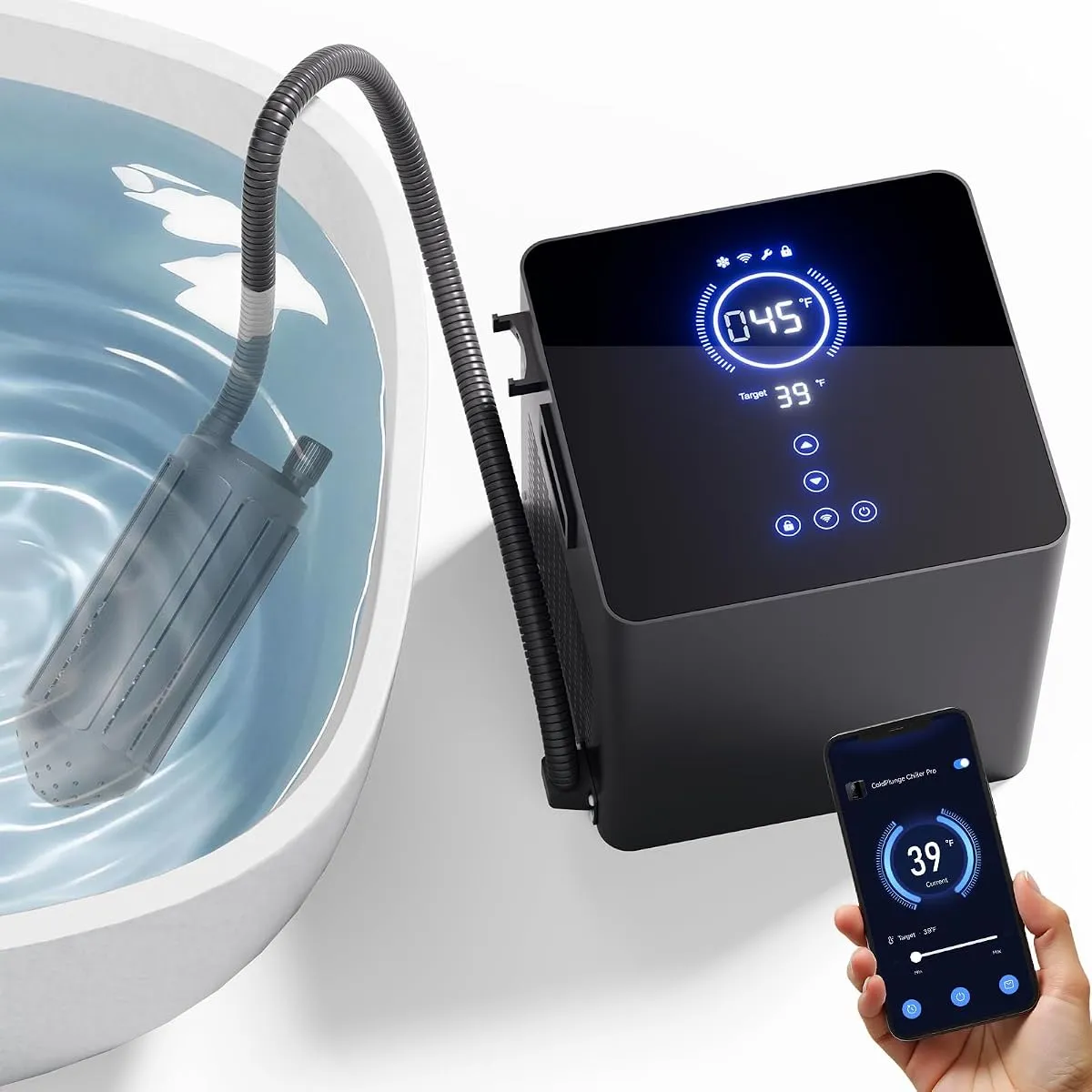
Nearly every unhappy chiller owner made a sizing mistake, not a brand mistake. Undersized units run constantly and still lose on a warm day. Oversized units cost more, draw more power, and short cycle.
The confusing part is that a chiller does two completely different jobs, and they need different amounts of machine. Most sizing advice conflates them, which is why people who follow it are still disappointed.
This page separates them, gives you the bands, and explains why the number on the box is optimistic.
The two jobs, which is the whole point
A chiller does two things. Almost all sizing confusion comes from treating them as one.
Job one: holding cold water cold
Your tub is at 52 degrees. The air is at 75. Heat leaks in through the walls and the surface, and the chiller replaces what leaks.
This is easy. The temperature gap is modest and the leak rate is slow, especially with a lid on an insulated tub. Almost any correctly sized unit cycles gently and keeps up indefinitely.
Job two: pulling a warm fill down
Your tub is at 70 degrees from the tap. You want 52. The chiller has to remove a large amount of heat from a large mass of water.
This is hard, and it is almost entirely a function of horsepower against volume.
Why this decides your purchase
If you leave the chiller running permanently, you do job one continuously and job two almost never. A modest chiller is fine, and it is cheaper to buy and run.
If you fill on demand and want to plunge the same afternoon, job two is your entire experience, and you need real headroom.
Decide which you are before looking at prices. It changes the answer completely, and no spec sheet will tell you.
The sizing bands
Start here.
| Tub volume | Chiller | Notes |
|---|---|---|
| Under 60 gallons | 1/10 to 1/4 HP | Bathtubs and small vertical tubs |
| 80 to 100 gallons | 1/3 HP | The most common home setup |
| 100 to 150 gallons | 1/2 HP | Long ovals, taller users |
| 150 to 250 gallons | 1 HP | Two people, or exceptional height |
| 250 gallons and up | More than 1 HP | Approaching commercial equipment |
Then apply the discount below.
Why the number on the box is optimistic
Manufacturer gallon ratings assume conditions you may not have:
- A covered tub. An open surface loses cold fast and gains heat from sun directly.
- Insulated walls. A bare PVC tub transfers heat through a single thin layer continuously.
- Mild air temperature. Ratings are not quoted for 95 degree afternoons.
Change any of those and effective capacity drops. A 79 gallon rated chiller on a bare 100 gallon tub in direct sun is not slightly stretched, it is losing.
Practical rule: if your tub is uninsulated or in sun, treat the rating as roughly two thirds of its label. If it is insulated and covered and shaded, the label is fair.
Fix the tub before you upsize the chiller
This is the advice that saves the most money and it is almost never given.
A lid plus external insulation costs a small fraction of stepping from 1/3 HP to 1/2 HP. It reduces the heat the chiller has to remove, permanently, every hour it runs.
So the order of operations is:
- Cover the tub.
- Insulate the tub.
- Site it out of direct sun.
- Only then consider a bigger chiller.
If you are choosing between a bigger chiller and an insulated cover, buy the cover. It is not close.
The oversizing trap
Bigger is not automatically safer.
An oversized chiller reaches the set point quickly, shuts off, the water warms slightly, and it starts again. Repeat all day. This is short cycling.
Compressors wear mostly at startup, not during steady running, so a unit that cycles heavily has a shorter life than one running long gentle cycles. You also paid more and you draw a larger surge each time it kicks in.
On a bathtub, a 79 gallon rated chiller will cycle constantly. On a 100 gallon tub it will run sensibly. Same unit, very different wear.
Power, which is a real constraint
Sizing is not only about water.
1/3 HP and below: ordinary appliance load. Runs from a normal outdoor socket, no electrician.
1/2 HP: usually fine, but check what else is on the circuit. Around 1200 watts sustained is enough to matter if it shares with lights and a shed.
1 HP and above: expect to need a circuit that is not shared. The startup surge is well above the running load, and that surge is what trips breakers, usually at an inconvenient hour.
Get the electrical work quoted before you buy a large chiller. In some gardens it costs more than the unit, and that can change which size makes sense.
Do not forget the pump
If the chiller does not include one, the pump’s flow rate has to suit it.
Too little flow and the water in the heat exchanger gets too cold, the unit ices up internally, and it short cycles or stops.
Too much flow and water passes through too quickly to lose meaningful heat, so it runs constantly and never reaches your set point.
Neither failure looks like a pump problem. Both look like a broken chiller. Buy the pump the chiller manufacturer specifies, or buy a unit with the pump built in and skip the problem.
Worked examples
85 gallon insulated soft tub, lid on, shaded, chiller left running. 1/3 HP. Comfortable, cheap to run, correct.
120 gallon oval, uninsulated, afternoon sun, filled on demand. 1/2 HP minimum and realistically 1 HP, because you are doing the hard job from warm against solar gain. Or insulate it and shade it and drop to 1/2 HP.
Bathtub, 45 gallons, refilled every session. 1/10 to 1/4 HP is the engineering match. A 1/3 HP unit cools it faster and cycles more; buy that only if a bigger tub is coming.
200 gallons, two people, permanent outdoor installation. 1 HP, on its own circuit, with the electrical work priced before purchase.
Where to go next
Our chiller comparison sorts units by the tub size they actually suit. If you would rather not match parts at all, the matched systems page covers tubs sold with a chiller already paired.
Common questions
What size chiller do I need for a cold plunge?
Match the chiller's gallon rating to your tub's real volume, then discount it if the tub is uninsulated or in the sun. Roughly: 1/3 HP for 80 to 100 gallons, 1/2 HP for 100 to 150, and 1 HP above that.
Is 1/2 HP enough for a cold plunge?
For up to roughly 150 gallons on a covered insulated tub, yes, comfortably. Above that, or on a bare tub in direct sun, it will run continuously and may not hold your set point on the hottest days.
Do I need 1 HP?
Only if your tub is over about 150 gallons, or you fill on demand and want to plunge the same day. If you leave the chiller running on a covered tub, 1 HP is usually capacity you pay for and never use.
Why are manufacturer gallon ratings optimistic?
Because they assume favourable conditions: a covered, insulated tub in mild air temperature. A bare tub in afternoon sun behaves like a much larger one, so the same chiller effectively has less capacity than the label suggests.
What happens if a chiller is too big?
It short cycles: reaching the set point fast, switching off, warming slightly, and starting again. Compressors wear at startup rather than during steady running, so heavy cycling shortens the unit's life.
Is it better to buy a bigger chiller or insulate the tub?
Insulate the tub, every time. A lid and some insulation cost a fraction of a chiller upgrade and reduce the work the chiller has to do permanently. It is the highest return purchase in any cold plunge setup.

Written by
Jed Callahan
Editor, Cold Plunge Daddy
I have spent more nights than I want to admit doing math on ice bath listings to find out whether the gallon number is a lie. It usually is. I have been in some of this gear and not all of it, and I always tell you which. I am not a doctor, and I am not going to pretend cold water fixed my life.
- Catching bad spec sheets
- Chiller sizing and power draw
- Warranty and return terms
- What a tub costs to run