
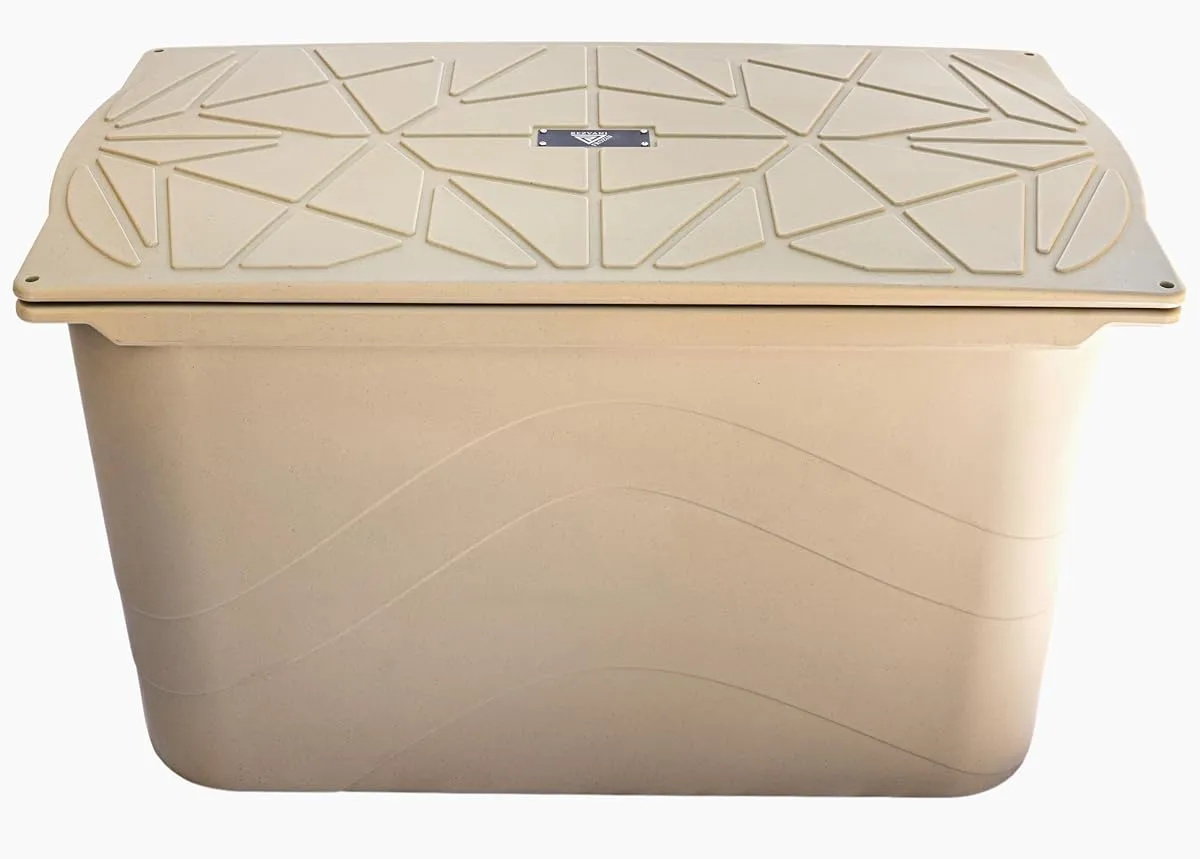
An outdoor cold plunge has to survive two things a soft indoor tub never faces: ultraviolet light, and freeze cycling.
UV destroys PVC and nylon over a couple of summers. Water left in a rigid shell through a hard freeze cracks it. Between them they explain why the outdoor shortlist is almost entirely rotomoulded plastic and resin.
The second question is whether the cold survives the day, because direct sun on a dark tub is a heat source rather than a neutral background.
We compared 12 tubs on shell material, insulation, footprint and how they handle a hot afternoon. Four made the page.
Watch: Best Overall, the Frozin 400 Cold Plunge Tub
The short answer
Every pick below wins one job. Find the line that sounds like you, then jump to the full write-up.
-
Best Overall
Frozin 400 Cold Plunge Tub
A permanent outdoor tub in a climate with real seasons, where you want ice to last and the shell to survive years of weather.
Check price on Amazon for Frozin 400 Cold Plunge Tub (opens in a new tab) Typically $800 to $2,000Read why it won for Frozin 400 Cold Plunge Tub -
Best Chilled Setup
248 Gallon Cold Plunge Tub with 1 HP Chiller
A permanent outdoor installation where two people plunge, or where summer heat makes ice impractical and you want the tub cold on demand.
Check price on Amazon for 248 Gallon Cold Plunge Tub with 1 HP Chiller (opens in a new tab) Typically $800 to $2,000Read why it won for 248 Gallon Cold Plunge Tub with 1 HP Chiller -
Best for Small Yards
Ice Cap Vertical Cold Plunge Tub
A balcony, a narrow side return, or any outdoor spot where floor area is the binding constraint rather than budget.
Check price on Amazon for Ice Cap Vertical Cold Plunge Tub (opens in a new tab) Typically $800 to $2,000Read why it won for Ice Cap Vertical Cold Plunge Tub -
Most Volume in a Small Footprint
118 Gallon Upright Ice Bath
A small outdoor space where you want maximum water volume for thermal stability and are willing to accept an unproven brand.
Check price on Amazon for 118 Gallon Upright Ice Bath (opens in a new tab) Typically $800 to $2,000Read why it won for 118 Gallon Upright Ice Bath
Compare them side by side
Same fields for every tub, so you are comparing like with like.
| Product | Award | Best for | Capacity | Dimensions | Material | Shape | Price | Where to buy |
|---|---|---|---|---|---|---|---|---|
| Frozin 400 Cold Plunge Tub | Best Overall | A permanent outdoor tub in a climate with real seasons, where you want ice to last and the shell to survive years of weather. | 100 gallons | 28"L x 48"W x 28"H | Low Density Polyethylene (LDPE) | Rectangular | $$$ $800 to $2,000 | Check price for Frozin 400 Cold Plunge Tub (opens in a new tab) |
| 248 Gallon Cold Plunge Tub with 1 HP Chiller | Best Chilled Setup | A permanent outdoor installation where two people plunge, or where summer heat makes ice impractical and you want the tub cold on demand. | 248 gallons | 60"L x 30"W x 32"H | Polyvinyl Chloride | Rectangular | $$$ $800 to $2,000 | Check price for 248 Gallon Cold Plunge Tub with 1 HP Chiller (opens in a new tab) |
| Ice Cap Vertical Cold Plunge Tub | Best for Small Yards | A balcony, a narrow side return, or any outdoor spot where floor area is the binding constraint rather than budget. | 100 gallons | 29"L x 29"W x 40"H | Food Safe Resin | Cylindrical | $$$ $800 to $2,000 | Check price for Ice Cap Vertical Cold Plunge Tub (opens in a new tab) |
| 118 Gallon Upright Ice Bath | Most Volume in a Small Footprint | A small outdoor space where you want maximum water volume for thermal stability and are willing to accept an unproven brand. | 118 gallons | 31.5"L x 31.5"W x 33.5"H | Stainless Steel | Rectangular | $$$ $800 to $2,000 | Check price for 118 Gallon Upright Ice Bath (opens in a new tab) |
The full reviews
Best Overall
Frozin 400 Cold Plunge Tub
Frozin 400
Foam insulated rotomoulded shell with a fitted lid, 100 gallons, 48 inches wide. Ice survives overnight outdoors and the shell does not care what the weather does.
What we like
- Foam insulation plus a lid, so ice lasts into a second day rather than a single session
- Rotomoulded LDPE handles sun, frost and standing outdoors year round
- 48 inch width lets most adults sit with legs extended rather than folded
- Lid included, which is what makes the insulation pay off outdoors
What we do not
- 90 pounds empty, so placing it is a two person job and a permanent decision
- Cannot be repaired if the shell cracks from a hard freeze left full
- No chiller included, so a chilled setup costs meaningfully more again
Key specs
- Capacity
- 100 gallons
- Dimensions
- 28"L x 48"W x 28"H
- Material
- Low Density Polyethylene (LDPE)
- Shape
- Rectangular
- Price range
- $800 to $2,000
Outdoors, two things decide whether a tub is any good: whether the shell survives the weather, and whether the cold survives the day. This gets both right.
Why insulation matters more outside than people think
The intuition is that a cold garden helps. Overnight in winter, it does.
Daytime in summer is the opposite. Direct sun on a dark tub is a heat source, and an uninsulated shell transfers that straight into your water. An insulated tub with a light coloured lid is fighting a much smaller battle.
Owners consistently report ice surviving overnight and into a second day with the lid on. We have not measured that ourselves, but the physics is straightforward and the reports are consistent.
Practically, that halves your running cost: one ice load covers two sessions.
The shell
Rotomoulded low density polyethylene is what good coolers and kayaks are made from. UV, frost and knocks do not trouble it in the way they destroy PVC, which is the difference between a tub that lasts five years outdoors and one that lasts one.
The shape
48 inches wide by 28 deep is sit-and-extend rather than sit-upright. That suits most adults better than a barrel, though much over six feet you will still be somewhat folded.
The freeze rule
This is the failure that costs money outdoors, and it is worth being blunt.
Water expands when it freezes. A sealed rigid shell full of freezing water is how four figure tubs crack, and that damage is frequently outside warranty.
If you are somewhere that drops properly below freezing, draining before a hard freeze needs to be routine. Soft tubs fail more often and fail cheaply. This rarely fails and fails expensively.
Siting it
90 pounds empty needs two people. Full it is going nowhere. Decide the spot before delivery, and answer the drainage question at the same time: 100 gallons has to go somewhere it will not undermine a foundation or kill a lawn.
Buy it if A permanent outdoor tub in a climate with real seasons, where you want ice to last and the shell to survive years of weather.
Skip it if You are new to cold plunging or you rent, because this is a fixed installation at roughly ten times the price of a capable soft tub.
The catch Rotomoulded LDPE is durable and not practically repairable. If the shell cracks from a hard freeze with water left in, there is no patch kit outcome. Draining before deep freezes has to become a habit rather than an intention.
Not tested by us. Specs checked July 25, 2026. How we research
Best Chilled Setup
248 Gallon Cold Plunge Tub with 1 HP Chiller
Drexo DREXO Cold Plunge Tub
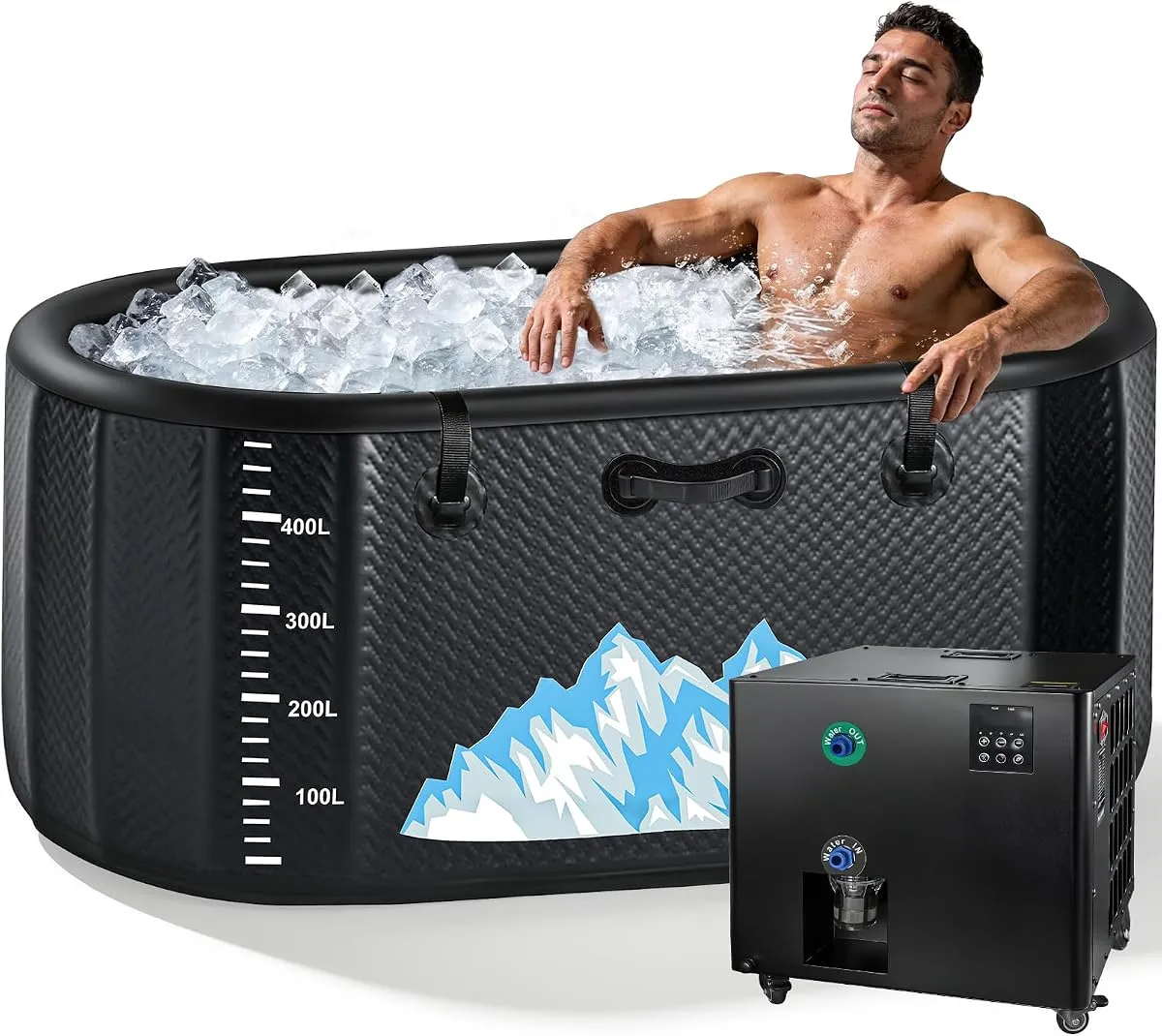
248 gallons with a full horsepower, so the tub is cold whenever you walk outside regardless of the weather. The outdoor setup that removes ice entirely.
What we like
- A matched chiller means summer heat and sun stop being your problem
- 248 gallons holds temperature through two back to back sessions
- Rigid shell built as a permanent outdoor installation
- Ends ice purchases, which is the recurring cost of any outdoor tub
What we do not
- Needs its own circuit in most homes, and outdoor wiring is real money
- 248 gallons is a long fill and more water to treat
- Compressor noise outdoors can carry to neighbours
Key specs
- Capacity
- 248 gallons
- Dimensions
- 60"L x 30"W x 32"H
- Material
- Polyvinyl Chloride
- Shape
- Rectangular
- Price range
- $800 to $2,000
Everything else on this page runs on ice. Outdoors in summer, ice is where the argument for a chiller becomes hard to avoid.
Why summer breaks the ice model
An uninsulated or lightly insulated tub in direct sun is being actively heated. You add 30 pounds of ice, the sun removes it, and you add more.
Insulation and a lid slow that down. A chiller removes it as a consideration entirely, which in a hot climate is the difference between plunging year round and plunging in winter only.
The volume advantage outdoors
248 gallons does two things beyond fitting two people.
More water changes temperature more slowly, so a hot afternoon moves it less than it would a 90 gallon tub. And with a properly matched 1 HP chiller, what does move is recovered quickly.
The result is a tub that sits at your set point regardless of what the day is doing.
The electrical reality
This is the cost people underestimate and it is worse outdoors.
A 1 HP compressor typically wants a circuit that is not shared, and running a proper outdoor rated supply to the far end of a garden means a trench, armoured cable and an electrician.
Get it quoted before you order. In some gardens it is a modest job. In others it exceeds the price of the tub, and that changes which setup makes sense.
Never run an indoor extension lead across wet ground to a compressor.
Noise, which matters more outside
Indoors a compressor is muffled by walls. Outdoors it is not, and sound carries.
If the tub sits near a boundary and you plunge early, think about that now. Siting the compressor behind a planted screen or on the house side of the tub helps. It is a placement problem with a placement solution, and the complaint appears often enough in owner reports that it is worth designing around.
Water volume knock-ons
A long fill from a garden hose, more sanitiser per dose, heavier filter load, and 248 gallons to dispose of when you drain it. Plan the drainage route before siting.
Buy it if A permanent outdoor installation where two people plunge, or where summer heat makes ice impractical and you want the tub cold on demand.
Skip it if You have no realistic route for a dedicated outdoor circuit, because that cost can exceed the difference to a much larger tub.
The catch A 1 HP compressor sitting outdoors is audible, and sound carries further outside than in. If the tub is near a fence line and you plunge at 6am, that is a neighbour conversation you should have before buying rather than after.
Not tested by us. Specs checked July 25, 2026. How we research
Best for Small Yards
Ice Cap Vertical Cold Plunge Tub
Ice Cap IC.TUB.MOO
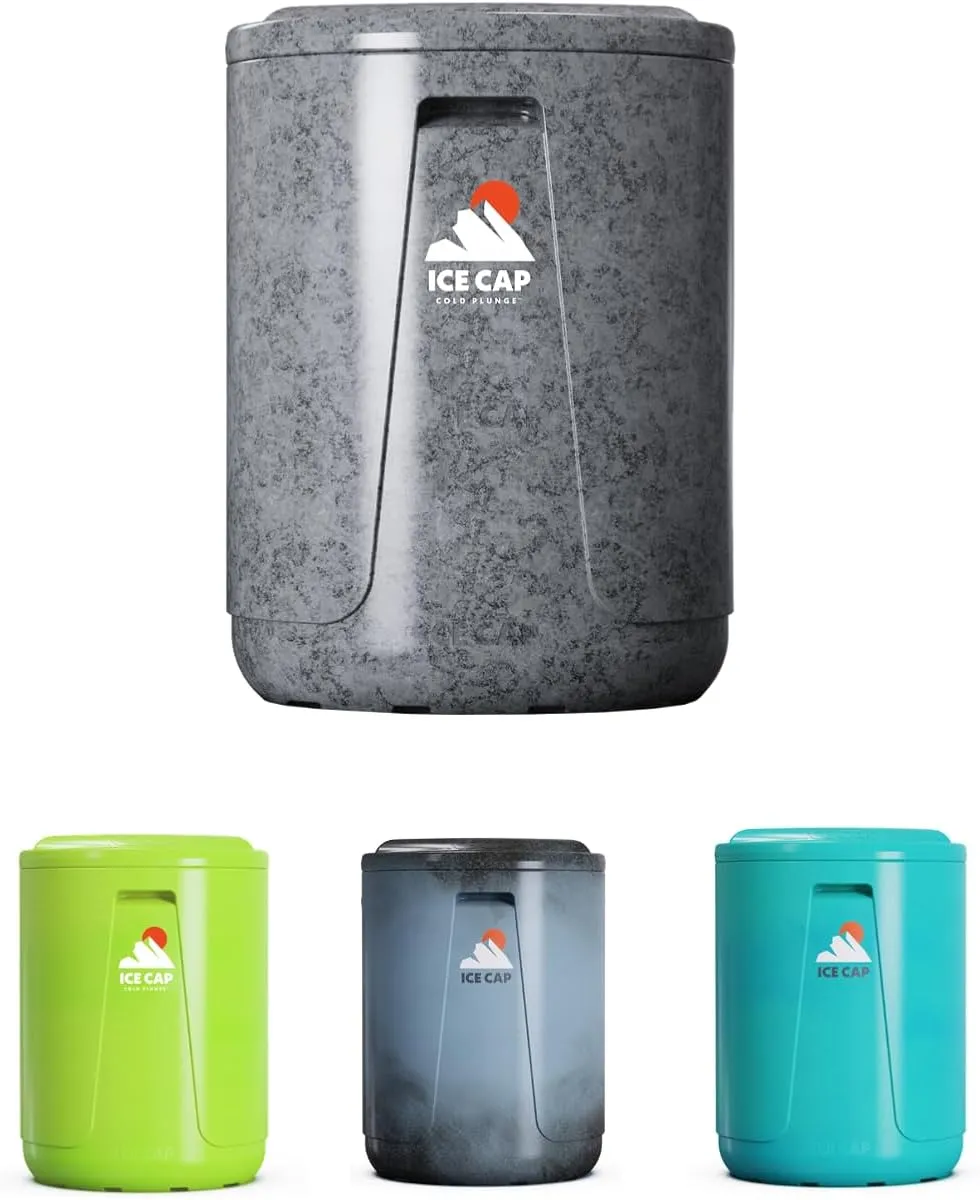
100 gallons on a 29 inch square, in a food safe resin shell rated for outdoor life. The tub for a balcony, a narrow side return or a corner of a patio.
What we like
- 29 by 29 inch footprint suits balconies and patios a wide tub cannot fit
- Resin shell handles sun and frost far better than any fabric tub
- 40 inch height puts water over the shoulders while seated
- Integrated step, which matters on wet decking
What we do not
- Only a couple of owner reports, so seasons of UV exposure are unproven
- Upright posture only, with no way to stretch out
- No chiller included at a price where some competitors bundle one
Key specs
- Capacity
- 100 gallons
- Dimensions
- 29"L x 29"W x 40"H
- Material
- Food Safe Resin
- Shape
- Cylindrical
- Price range
- $800 to $2,000
Someone else's Ice Cap Vertical Cold Plunge Tub review
Watch "Ice Cap Cold Plunge Tub Review - Ryan Humphries of Engearment.com" on YouTube
Most outdoor cold plunge advice assumes a garden. Plenty of people have a balcony, a narrow passage beside a house, or a patio already full of other things.
Footprint is the whole argument
29 by 29 inches is roughly a dining chair. A tub holding the same 100 gallons lying down needs four to five feet of length plus access.
If your outdoor space is measured in feet rather than yards, that trade is the one that makes a cold plunge possible at all.
It uses height rather than width
40 inches tall with an internal bench, so the water sits over your shoulders while seated. Most 29 inch round tubs put it at mid chest.
So the small footprint does not cost you immersion depth, which is unusual and is the reason this beats a barrel of the same width.
Resin outdoors
Food safe resin is a proper outdoor material. It handles frost and sun in a way PVC and nylon do not, which is the main reason to buy rigid rather than soft for a permanent outdoor tub.
The unknown
Two owner reviews, and outdoors that gap is more significant than it would be inside.
UV is what kills plastics over years. A resin shell should handle it well, and “should” is doing real work in that sentence, because nobody has published a UV rating and nobody has owned one through five summers.
If you want certainty outdoors, the rotomoulded tubs have far more history. If you need the footprint, this is the only thing that fits and you are accepting an unproven material.
Balcony specifics
Two things if this is going on a balcony.
Weight. 100 gallons is roughly 830 pounds plus a person, on under six square feet. Balconies have load limits and they are lower than floors. Check yours; this is not a formality.
Drainage. 100 gallons off a balcony has to go somewhere that is not a neighbour’s furniture. Work out the route before you fill it.
Buy it if A balcony, a narrow side return, or any outdoor spot where floor area is the binding constraint rather than budget.
Skip it if You want to lie back, because a vertical tub offers no version of that whatever the weather.
The catch Almost no owner history exists for this model, and outdoors that gap matters more than indoors. UV is what destroys plastics over years, and nobody has yet owned one of these through enough summers to tell you how the resin holds up.
Not tested by us. Specs checked July 25, 2026. How we research
Most Volume in a Small Footprint
118 Gallon Upright Ice Bath
ALEKO RBCHTUB-FBM
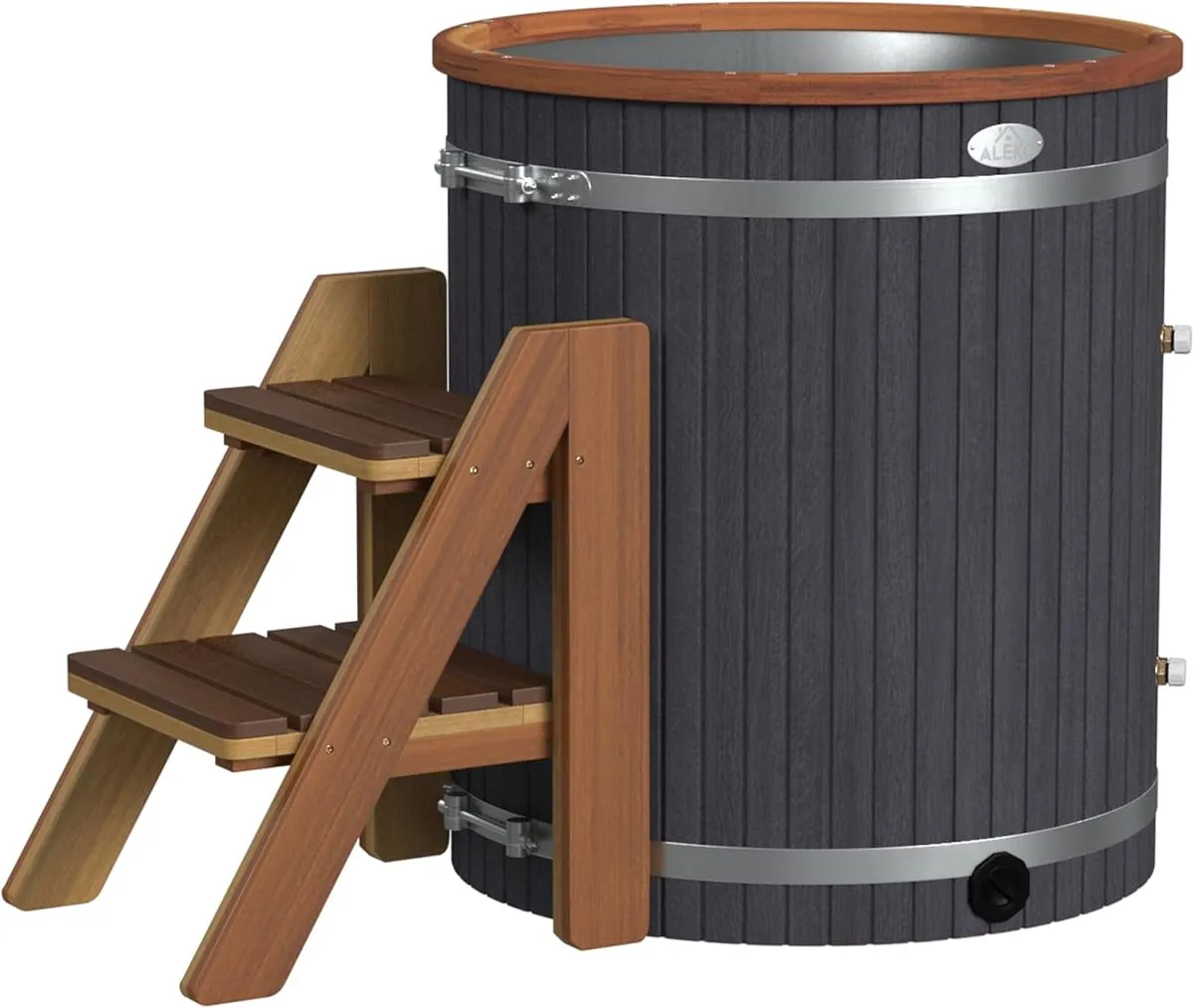
118 gallons upright, the most water of any small footprint tub here. More volume resists a hot afternoon better, and the review base is thin enough to be a real risk.
What we like
- 118 gallons is the largest volume available in an upright footprint
- More water changes temperature more slowly, which helps outdoors in summer
- Full spec sheet published, unlike the established barrels
- Upright form keeps the ground footprint small on a patio
What we do not
- Very few owner reviews and the average rating is poor
- More water means proportionally more ice per session without a chiller
- Priced against brands with far longer outdoor track records
Key specs
- Capacity
- 118 gallons
- Dimensions
- 31.5"L x 31.5"W x 33.5"H
- Material
- Stainless Steel
- Shape
- Rectangular
- Price range
- $800 to $2,000
Thermal mass is an underrated outdoor spec. More water moves less when the sun hits it, and this holds more water than anything else with a small footprint.
Why volume helps outdoors specifically
Indoors the room temperature is steady. Outdoors it swings, sometimes 30 degrees between dawn and mid afternoon.
A larger volume of water absorbs that swing with a smaller temperature change. 118 gallons is meaningfully more stable across a hot day than 77 gallons in the same footprint, which is the practical argument for this over the Ice Barrel 300.
It publishes its specs
Worth noting because the established barrels do not. Capacity, dimensions, weight, material and shape are all here, so you can check whether it fits your patio and whether you can move it before it arrives.
That should be the baseline for a permanent outdoor purchase and most of this category fails it.
The problem, plainly
Very few owners, and the small sample is not enthusiastic.
Outdoors this gap matters more than it would indoors. Sun and freeze cycling are what expose a badly made shell, and both take years to show. Nobody has owned one of these through enough seasons to tell you anything.
Rotomoulded plastic is a simple, forgiving material, so the odds are reasonable. Odds are not evidence, and at four figures the established alternatives have hundreds more owners between them.
The ice arithmetic cuts the other way
The extra volume that makes it thermally stable also makes it more expensive to run on ice. 118 gallons needs meaningfully more per session than 77.
So this tub makes most sense with a chiller, where the extra volume costs almost nothing and buys you a steadier temperature. On bagged ice, the smaller barrels are cheaper to own.
Buy it if A small outdoor space where you want maximum water volume for thermal stability and are willing to accept an unproven brand.
Skip it if You want reassurance about how a shell survives years of sun, because that is exactly what the missing review history would have told you.
The catch The review base is very small and skews negative. Outdoors that matters more than indoors, because UV and freeze cycling are what expose a poorly made shell, and nobody has owned one long enough to report on either.
Not tested by us. Specs checked July 25, 2026. How we research
How we compared these
Twelve tubs, judged on what a garden does to them.
Shell material and UV. The single biggest determinant of outdoor lifespan. Rotomoulded plastic and resin last years. PVC and nylon do not.
Insulation and a lid. Outdoors these fight the sun, not just the night air.
Footprint against usable depth. A balcony and a lawn are completely different constraints.
Freeze risk. A rigid shell full of freezing water is the expensive outdoor failure.
Summer strategy. Whether the tub can stay cold on ice through a hot afternoon, or whether it really needs a chiller.
The two things that kill outdoor tubs
Ultraviolet light
This is why soft sided tubs are not outdoor tubs, whatever the listing says.
PVC and nylon become brittle under sustained UV. A tub left uncovered on a patio through two summers develops cracks at fold lines and around seams. Kept covered and out of direct sun it lasts considerably longer, which is why every soft tub owner who keeps theirs going is diligent about the cover.
Rotomoulded polyethylene and food safe resin are the materials designed for this. They are why the outdoor shortlist looks the way it does.
Freeze cycling
Water expands when it freezes. A sealed rigid shell full of freezing water is how four figure tubs crack, and that damage is frequently outside warranty.
Draining before a hard freeze has to become routine rather than an intention. The good news is that winter is exactly when you least need the tub standing full, because the air is doing the cooling for you.
Summer is the real problem, not winter
This surprises people. Winter is easy: the air is cold and ice lasts.
Summer is where outdoor tubs get expensive. Direct sun on a dark shell is an active heat source. You add 30 pounds of ice, the sun takes it back, and you add more. In a hot climate an uninsulated outdoor tub on ice becomes impractical from roughly June to September.
Three fixes, cheapest first:
- Shade. Free. Site the tub where it does not bake, or put up a sail.
- Insulation and a light coloured lid. Modest cost, large effect.
- A chiller. Solves it completely and costs the most. Our chiller guide covers sizing.
If you live somewhere with hot summers and you want to plunge year round, the honest answer is that a chiller stops being optional.
Siting an outdoor tub
Answer these before delivery, not after.
A level load bearing base. 100 to 250 gallons is 830 to 2,100 pounds. Grass compacts and tilts. A slab, pavers or a properly built deck is the answer, and a tilted tub is both unpleasant and hard on the shell.
Drainage. Where does the water go? Not against a foundation, and not repeatedly onto the same patch of lawn.
Power, if a chiller is even possible. A proper outdoor rated supply. Running a lead from indoors across wet ground to a compressor is not an acceptable substitute.
Noise and neighbours. A compressor outdoors carries. Worth thinking about if you plunge early and the tub sits near a boundary.
Shelter and access. Somewhere you will actually walk to in February, ideally with a short route back inside.
Our final recommendation
For most gardens the Frozin 400 is the right outdoor tub. Foam insulated rotomoulded shell, lid included, wide enough to sit properly, and built to stay out year round. Drain it before hard freezes and it will outlast several soft tubs.
If summers where you live are hot and you want to plunge through them, skip the ice question and buy the 248 gallon chilled system. Get the outdoor circuit quoted before you order, because in some gardens that cost exceeds the tub.
If your outdoor space is a balcony or a narrow side return, the Ice Cap is the only thing here that fits, and it gets water over your shoulders while doing it. Check your balcony’s load limit first, and accept that its long term UV performance is unproven.
The 118 gallon upright has the most thermal mass in a small footprint, which genuinely helps in summer. It also has almost no owner history. At this price that is a real trade rather than a find.
How we researched this page
We compared 12 tubs on shell material and UV resistance, insulation and whether a lid is included, footprint against usable depth, freeze risk, and what it takes to keep the water cold through a hot afternoon rather than a cool night.
What we worked from
- Manufacturer spec sheets
- Brand manuals and setup docs
- Verified owner reports
- Warranty terms
- Price history
- Retailer listing data
12 units were compared before these 4 made the page.
What we handled ourselves
None of the products on this page. Nobody can buy every tub on the market and we are not going to pretend otherwise.
What we could not confirm, product by product
- Frozin 400 Cold Plunge Tub
- Insulation performance is the brand's claim. Owner reports describe multi-day ice retention but we found no controlled measurement, and we could not confirm the warranty position on freeze damage.
- 248 Gallon Cold Plunge Tub with 1 HP Chiller
- No measured noise level or timed pull down. Owner reports are thin for this model, so our reliability read is weaker than for the established rotomoulded tubs.
- Ice Cap Vertical Cold Plunge Tub
- Very few owner reports, so long term UV and freeze durability are unproven. We could not confirm the resin's UV rating, which is the spec that would answer it.
- 118 Gallon Upright Ice Bath
- Too few owner reports to judge shell durability, UV resistance or freeze behaviour, and the small sample rates it below the established barrels.
Questions people ask before they buy
Can you leave a cold plunge outside all year?
A rigid rotomoulded or resin tub, yes. A soft sided PVC tub, no: UV degrades it within a couple of summers. The real risk in either case is water left in the tub through a hard freeze, which can crack a rigid shell.
Will an outdoor cold plunge freeze solid in winter?
In a hard freeze it can, and that is what cracks shells. Drain before deep freezes. Ironically winter is when an outdoor tub needs the least help staying cold, so there is no loss in emptying it.
Does sun make an outdoor cold plunge unusable in summer?
It makes ice much more expensive. Direct sun on a dark tub is a heat source. Insulation plus a light coloured lid helps a lot; a chiller removes the problem. Siting it in shade is the free version.
What material lasts longest outdoors?
Rotomoulded low density polyethylene, the material used for good coolers and kayaks. Food safe resin is close behind. Both handle sun and frost far better than PVC or nylon.
Do I need a cover outdoors?
Yes, and more than indoors. A cover keeps sun off the water, keeps leaves and debris out, and holds cold overnight. It is the cheapest thing you can add to an outdoor tub.
Where should I put an outdoor cold plunge?
On a level load bearing base, in shade if you can, near a drain, and within reach of a proper outdoor socket if a chiller is likely. Also think about where 100 to 250 gallons goes when you empty it.
Why you can trust this page
- Who wrote it
- Jed Callahan, Editor, Cold Plunge Daddy
- When
- Published July 25, 2026, updated July 25, 2026
- How we picked
- We compared 12 tubs on shell material and UV resistance, insulation and whether a lid is included, footprint against usable depth, freeze risk, and what it takes to keep the water cold through a hot afternoon rather than a cool night.
- What we looked at
- 4 products made this page after the cut.
- How we make money
- Amazon pays us a small commission when you buy through our links. Nobody pays us for a good review and no brand sees a page before it goes live.
- What we do not do
- We do not run these tubs ourselves, so we never claim we did. Every pick here comes from spec sheets, manuals, warranty terms and owner reports, and each review says what we could not check.

Written by
Jed Callahan
Editor, Cold Plunge Daddy
I have spent more nights than I want to admit doing math on ice bath listings to find out whether the gallon number is a lie. It usually is. I have been in some of this gear and not all of it, and I always tell you which. I am not a doctor, and I am not going to pretend cold water fixed my life.
- Catching bad spec sheets
- Chiller sizing and power draw
- Warranty and return terms
- What a tub costs to run