
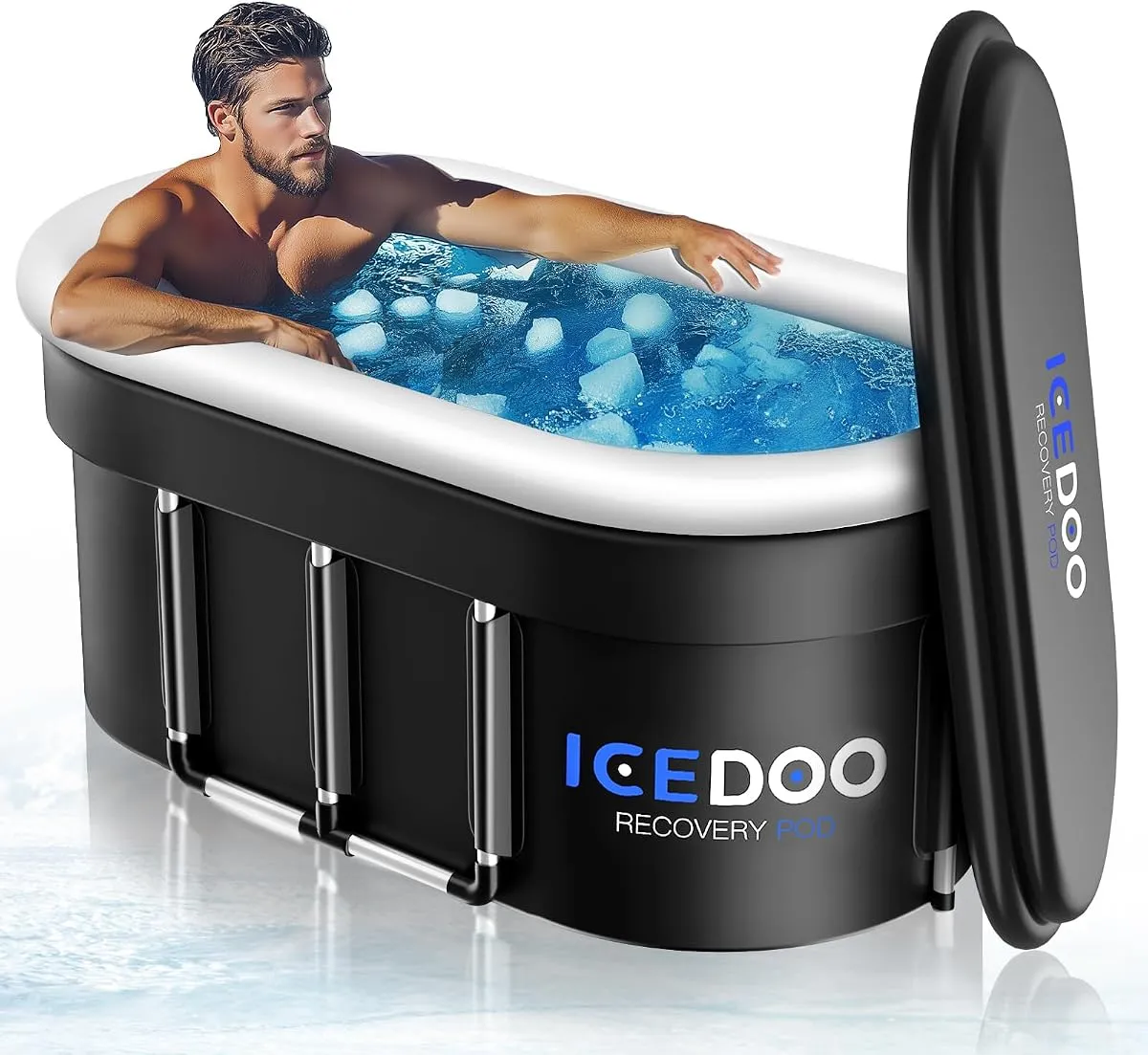
Gallons is the number every listing shouts and the least useful one for deciding whether you fit. It is also the number most often wrong.
What decides whether a tub works for your body is depth, then length, then width. Three measurements, in that order, checked against you rather than against an average.
This page gives you those numbers, explains what each one changes about the session, and shows you how to test a listing's capacity claim in about thirty seconds. That last part matters, because across the tubs in our catalog we found advertised capacities up to 70 percent higher than the tub's own dimensions allow.
The three numbers, in order
Listings lead with gallons because it is the biggest number. Here is the order that actually decides whether a tub works.
1. Depth. Whether your shoulders go under. The one that ruins a tub if you get it wrong.
2. Length. Whether your legs extend. Only matters above roughly six foot, and then it matters enormously.
3. Width. Whether your shoulders and elbows have room. Rarely a problem, occasionally decisive.
4. Gallons. What it costs to run. A cost, not a benefit.
Read them in that order and you will not buy the wrong tub.
Depth: the number that matters most
The point of a cold plunge is getting your torso under water. If the water stops at your ribs you are slouching for ten minutes, and slouching is how people talk themselves out of the habit.
What you need: 24 to 30 inches of water above where you sit, for most adults.
What that means in tub height: more than you think. A tub 30 inches tall does not give you 30 inches of water. You lose two or three inches at the top because nobody fills to the rim, and you displace water when you get in, which raises the level but also means you sink lower. Assume the usable depth is roughly three to five inches less than the tub’s stated height.
Practical bands:
| Tub height | Usable water depth | Suits |
|---|---|---|
| 24 to 26 inches | Around 20 to 22 inches | Shorter adults, or ribs down only |
| 28 to 30 inches | Around 24 to 26 inches | Most adults, shoulders under seated |
| 31 to 33 inches | Around 27 to 29 inches | Broad or tall torsos, neck deep |
Most inflatable tubs cluster at 29 to 31 inches, which is why the category mostly works. The ones to be careful about are the shallow wide ones, which look generous and leave you sitting in a puddle.
Measure yourself: sit on the floor, and have someone measure from the floor to the top of your shoulder. That is the water depth you want. It surprises people.
Length: only matters if you are tall
Under about five foot ten, ignore this. A 29 inch round tub is fine and you will sit cross-legged or with knees up.
Over six foot, this is the whole ballgame. A round tub 29 inches across forces a choice every single session: knees under and shoulders out, or shoulders under and knees out. Owners describe that as the thing they regret, not the temperature.
The fix is shape, not volume. An oval or rectangular tub 50 inches or longer lets your legs extend in front of you. Going from a 29 inch round tub to a 55 inch oval changes the experience completely and only adds moderately to the water volume, because ovals are narrow.
Rough guide:
- Up to 5’10”: 29 to 31 inch round is fine
- 5’10” to 6’2”: 46 to 50 inch oval is comfortable
- Over 6’2”: 55 inches or more, or accept knees up
Our inflatable ice bath guide has a 55 inch oval whose capacity claim actually checks out, which is rarer than it should be.
Width: the quiet one
Most people never hit a width limit, but two groups do.
Broad shoulders. Below about 26 inches of internal width, a broad person’s shoulders touch the walls, and on a soft tub that means pushing the wall out every time you shift.
Anyone who wants their arms in. Arms out on the rim is normal and fine. Arms submerged needs a few more inches, and it makes a real difference to how cold the session feels, because forearms shed heat quickly.
Rectangular tubs win here. Round tubs give you width and depth at the same point, so the widest part is exactly where your shoulders are, which is why 29 inch round tubs work better than their footprint suggests.
Gallons is a running cost, not a feature
This is the part listings never frame honestly.
Water volume determines what a session costs you. Not once, every time.
With ice: a 132 gallon tub needs roughly half again the ice of an 85 gallon tub to reach the same temperature. At four sessions a week that difference alone can run to a meaningful annual sum, and it never stops.
With a chiller: more water is more thermal mass to pull down and hold, so a bigger tub needs a bigger chiller, which costs more to buy and more to run. Our chiller sizing guide covers where the bands fall.
So the correct instinct is the opposite of the usual one. Buy the smallest tub you genuinely fit in. Extra gallons above what your body needs are pure cost.
Insulation changes this more than size does. An insulated 85 gallon tub with the cover on will cost you far less to keep cold than an uninsulated 100 gallon one, and it holds yesterday’s cold into today.
How to check a capacity claim in thirty seconds
We run this on every tub in our catalog and it fails often enough to be worth your time.
The arithmetic:
- Take the listing’s own length, width and height in inches.
- Multiply them together.
- For a round or oval tub, multiply by 0.79. For a rectangular one, skip this.
- Divide by 231.
The result is roughly how many gallons it holds filled to the very brim, which is more than you will ever put in it.
What we found doing this across our catalog:
- One tub advertises 133 gallons next to dimensions that hold about 79. The claim is roughly 70 percent too high.
- Several publish their folded carton size instead of the tub, so the capacity cannot be checked at all. One 135 gallon tub lists dimensions of 23 by 8 by 12 inches.
- A few quote conservatively, below their brim-full volume, which is a good sign about whoever wrote the spec sheet.
If a listing fails this test, do not assume it is lying. These fields are usually filled in carelessly. But it does tell you the spec sheet was not checked, and the same listings frequently get the material wrong too. We have seen folding fabric tubs described as cast iron, aluminium, acrylic and stainless steel.
Two people, and why it is harder than it looks
A genuine two person tub needs roughly 60 inches of length and 40 of width, which puts you above 200 gallons.
Most tubs marketed as “1 to 2 person” are one person tubs you can technically share. Check the dimensions against two bodies rather than trusting the label.
And be honest about the running cost. Doubling the water doubles the ice, and it pushes you into a larger chiller band. Two people plunging together in a small tub, one after another, is usually the better answer than one big tub.
What we would buy
Most adults, one person, ice: a tub 29 to 31 inches tall and about 29 across, insulated, 85 to 105 gallons. Shoulders under, cheapest to run.
Over six foot: an oval 50 inches or longer, and accept the extra ice or go to a chiller.
Broad build: rectangular, at least 28 inches of internal width, 30 inches tall.
Whatever the size: insulated, with the cover included. Insulation saves you more money than choosing a smaller tub does, and it is the spec most listings describe worst.
Our cold plunge tub comparisons list real dimensions for every tub, with the impossible ones removed.
Common questions
What size cold plunge tub do I need?
Depth is the first number: you want at least 24 inches of water above the seat, which usually means a tub 28 inches tall or more. Then length, which only matters above roughly six foot. Most adults under five foot ten fit a 29 inch round tub. Taller than that and you want an oval 50 inches or longer.
How deep should a cold plunge be?
Deep enough that water covers your shoulders while you sit normally, which for most adults means 24 to 30 inches of water. Tub height is not water depth: you lose a few inches at the top, and more once your body displaces the water. Buy taller than the depth you want.
Do I need a bigger cold plunge if I am tall?
Longer, not bigger. A tall person in a 29 inch round tub has to choose between knees under and shoulders under. An oval 50 inches or more lets legs extend, and that fixes the problem without much extra volume. Height alone is not what you are buying.
Is a bigger cold plunge better?
No, and it costs you. Water volume drives your ice bill and your chiller's workload. A 132 gallon tub needs roughly half again the ice of an 85 gallon tub for the same temperature, every session. Buy the smallest tub you genuinely fit in.
What size cold plunge fits two people?
Realistically 60 inches of length and 40 of width, which puts you well past 200 gallons. Very few tubs marketed as two person are actually that big. Check the dimensions rather than the label, and accept that the running cost roughly doubles.
How do I check if a tub's gallon claim is real?
Multiply the listing's own length, width and height in inches. For a round or oval tub multiply by 0.79. Divide by 231. That is roughly the brim-full gallons. If the answer is far below the advertised figure, the listing is wrong.
How many gallons is a typical cold plunge?
Most one person tubs land between 85 and 135 gallons. Below 85 the water sits low unless you are small. Above 150 you are usually paying for water you do not use, in ice or in electricity.

Written by
Jed Callahan
Editor, Cold Plunge Daddy
I have spent more nights than I want to admit doing math on ice bath listings to find out whether the gallon number is a lie. It usually is. I have been in some of this gear and not all of it, and I always tell you which. I am not a doctor, and I am not going to pretend cold water fixed my life.
- Catching bad spec sheets
- Chiller sizing and power draw
- Warranty and return terms
- What a tub costs to run