
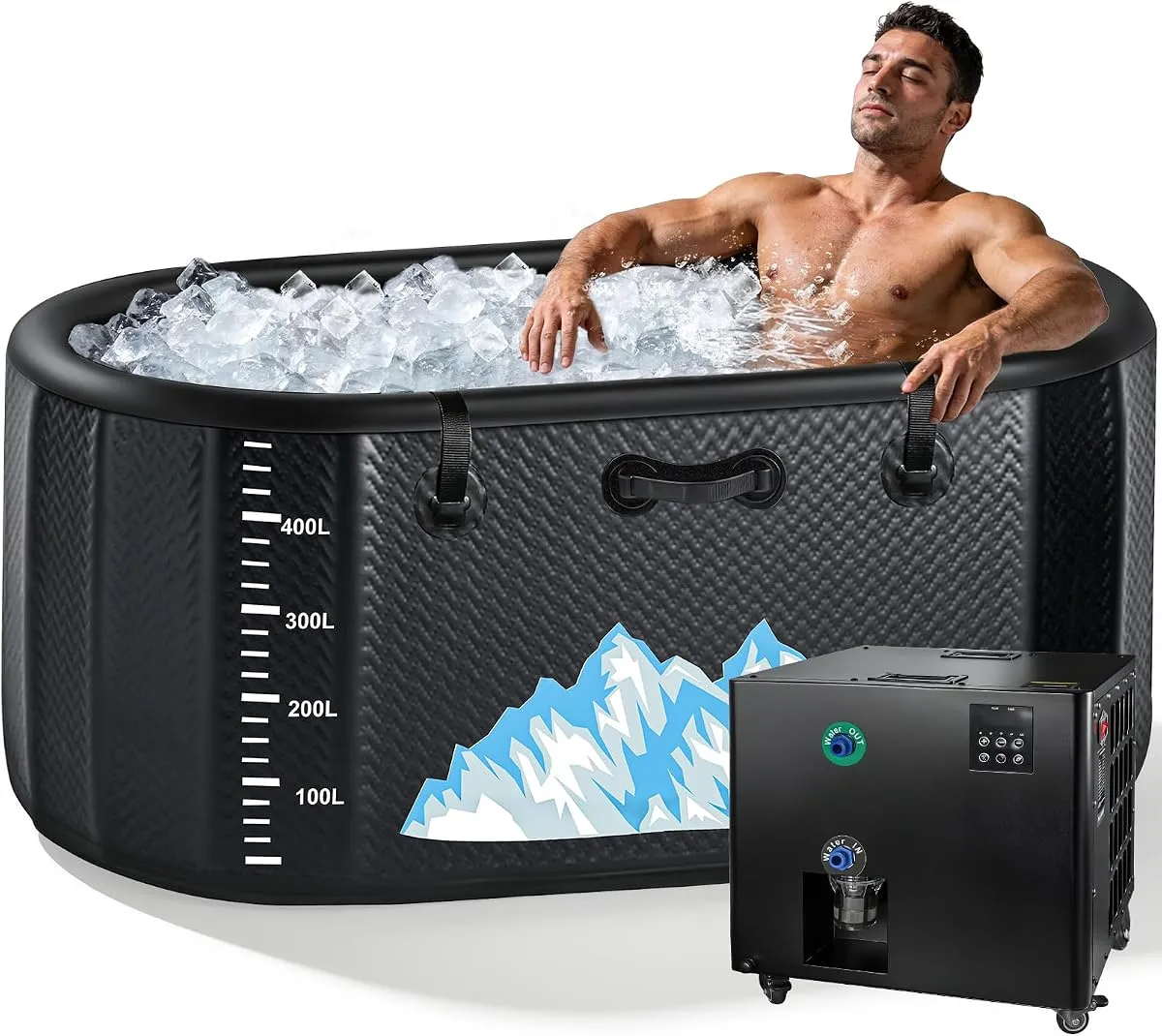
A cold plunge pool means one of two very different things, and the price gap between them is enormous.
It can mean a built-in, excavated, plumbed pool kept at 50 to 59 degrees. That is a construction project with a five figure budget and a permit conversation.
Or it can mean a large above-ground tub with a chiller, which delivers the same water temperature for a small fraction of the cost.
This page covers what actually drives the price of the first, and when the second is simply the better answer. We do not sell or install pools; this is a buyer's view of the numbers.
Two very different things
A built-in cold plunge pool is excavated or set into a deck, plumbed, with a shell, filtration, a chiller sized for the volume, and finishes. It is a construction project.
An above-ground cold plunge tub with a chiller sits on a level pad, plugs into an outdoor socket, and holds the same water at the same temperature.
The water is identical. What differs is permanence, appearance, and roughly an order of magnitude in cost.
Most people asking about cold plunge pools want the second thing and have not been told it exists at that price.
What drives the cost of a built-in
If you are genuinely considering the construction route, these are the line items that matter, roughly in order of size.
Excavation and groundworks. Access is everything. A machine that can reach the spot costs a fraction of the same job done by hand, and rear gardens with no side access are where budgets triple.
The shell. Concrete, fibreglass or a prefabricated plunge shell. Prefabricated is cheaper and faster; concrete is what you use when the shape is unusual.
Plumbing and filtration. A pool needs circulation and filtration regardless of temperature. This is standard pool work and priced as such.
The chiller. Here is where cold plunge pools diverge from ordinary pools, and where people underestimate.
Electrical. A commercial chiller is a serious load. A dedicated circuit, often three phase for the larger units, plus the run to the pool.
Finishes and surrounds. Coping, decking, steps, a cover. Easy to underspend at the design stage and regret.
The chiller is the part that scales badly
Cooling capacity has to match volume, and volume grows fast with size.
The domestic chillers sold for cold plunge tubs top out around 1 to 1.5 HP and are rated for roughly 150 to 250 gallons. A modest built-in plunge pool starts around 500 gallons and climbs quickly.
That pushes you into commercial refrigeration: bigger compressors, three phase power, proper installation. The equipment cost is a multiple of a domestic unit and so is the running cost, because you are holding several times the water at temperature continuously.
This is the single strongest argument for keeping a cold plunge small. Every extra gallon is a cost you pay every day, forever.
Why chilling a swimming pool almost never works
People ask this and the maths answers it.
A domestic swimming pool holds ten to fifty times what a plunge pool holds. Cooling that volume to the low 50s, and holding it there against sun and air temperature across a large surface area, requires industrial equipment and industrial running costs.
Surface area is the part people miss. A pool loses and gains heat across its whole surface, and a plunge pool has a fraction of it.
If you have a pool and want cold immersion, put a plunge tub next to it. That is what most people with both end up doing.
The sensible middle ground
Two options that get most of the built-in feel without the project.
A rigid tank set into a deck. Build a deck around a rotomoulded tank or trough so the rim sits flush. From above it reads as built-in. Underneath it is a container you could replace in an afternoon, and a domestic chiller handles the volume. Our tanks comparison covers the containers that suit this.
A large above-ground system on a proper pad. A 200 to 250 gallon tub with a matched 1 HP chiller, on a level base with tidy surrounds. Our machines guide covers these, and the honest observation is that they deliver the same immersion experience as a built-in pool.
If you are still building one
Three things worth insisting on.
Keep it small. Resist the urge to size it for swimming. Shoulders under and legs extended is the requirement, and roughly 150 to 300 gallons achieves it. Every gallon beyond that is a permanent running cost for no benefit.
Insulate the shell. Pools are usually built to hold heat in summer, not cold in summer. Insulating the shell and specifying a proper insulated cover changes the running cost materially, and it is far cheaper to do during construction than after.
Get the chiller sized by someone who will stand behind it. An undersized chiller on a built-in pool is an expensive mistake with no cheap fix, unlike a tub where you simply buy a bigger unit.
Our honest view
If you want cold water, buy a tub and a chiller. It is the same water for a fraction of the money, and you can change your mind.
Build a plunge pool if you want a permanent architectural feature, you are already doing landscaping, and the appearance genuinely matters to you. Those are good reasons. Water temperature is not one, because a $2,000 setup and a $40,000 one both sit at 52 degrees.
Common questions
How much does a cold plunge pool cost?
A built-in excavated plunge pool with chilling is a five figure project once you include excavation, shell, plumbing, a commercial grade chiller, electrical work and finishes. A large above-ground tub with a matched chiller does the same job for a small fraction of that.
Can you chill a normal swimming pool?
Technically yes and almost never sensibly. Chilling capacity scales with volume, and a domestic pool holds ten to fifty times what a plunge pool does. The equipment and running cost become industrial very quickly.
What size should a cold plunge pool be?
Small. The point is immersion, not swimming. Enough to sit with your shoulders under and extend your legs is plenty, which is roughly 150 to 300 gallons. Every extra gallon costs money to cool forever.
Do cold plunge pools need a special chiller?
They need one sized for the volume, which usually means commercial equipment rather than the domestic units sold for tubs. That step up in equipment is a large part of why built-in pools cost what they do.
Is a plunge pool worth it over a tub?
Only if you want the built-in look and the permanence, or you are adding it alongside other landscaping anyway. On water temperature and immersion, a good tub with a matched chiller is identical.
What about a stock tank or container pool?
A rigid tank sunk partly into a deck gets you most of the built-in look for a tiny fraction of the cost. It is the most common sensible middle ground and it is worth looking at before committing to excavation.

Written by
Jed Callahan
Editor, Cold Plunge Daddy
I have spent more nights than I want to admit doing math on ice bath listings to find out whether the gallon number is a lie. It usually is. I have been in some of this gear and not all of it, and I always tell you which. I am not a doctor, and I am not going to pretend cold water fixed my life.
- Catching bad spec sheets
- Chiller sizing and power draw
- Warranty and return terms
- What a tub costs to run