
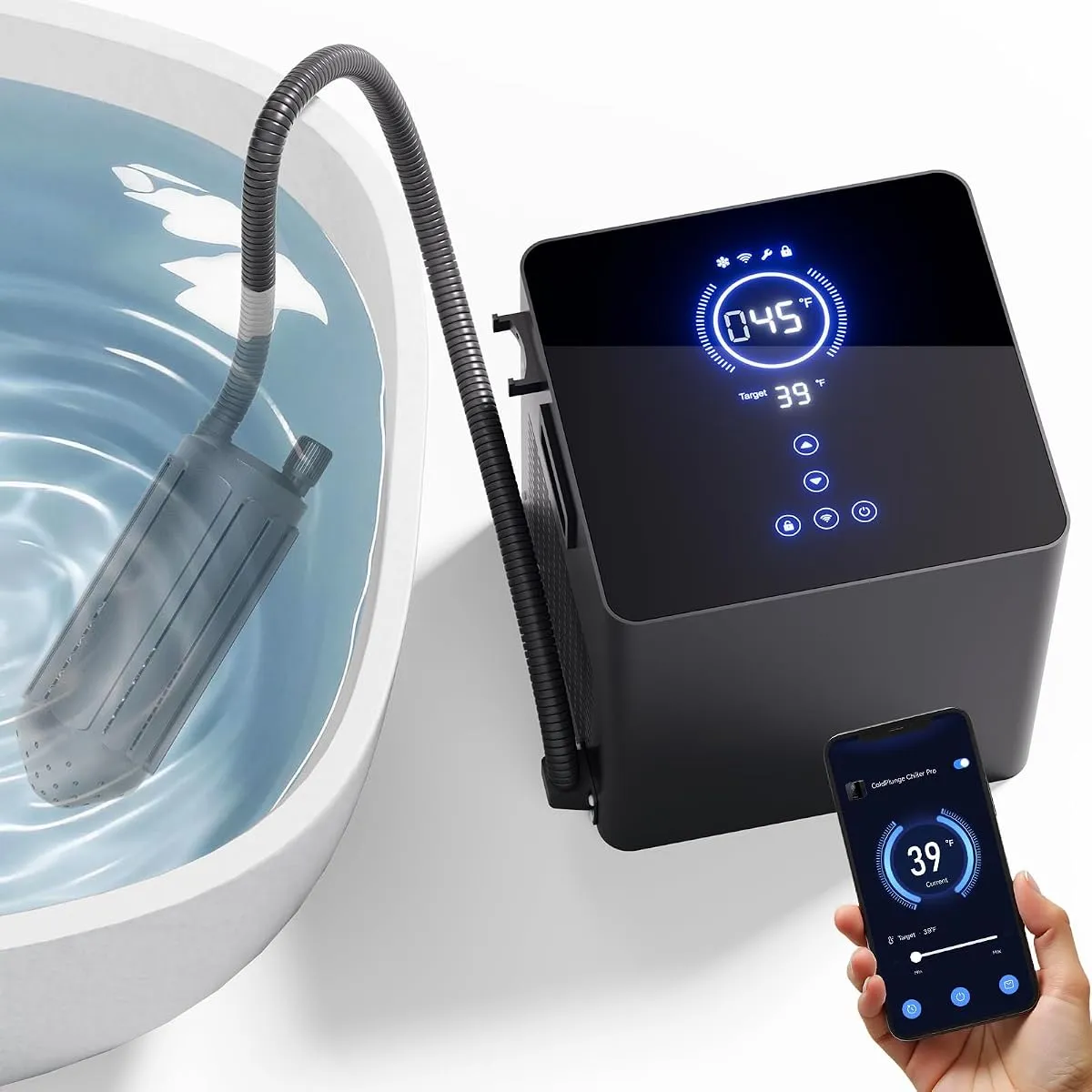
A cold plunge chiller is a refrigeration unit, and refrigeration units are sold by four different industries. Aquarium suppliers, hydroponics shops, cold plunge brands and generic marketplace sellers all list the same class of machine, and they publish completely different things about it.
That is the actual problem when you go shopping. It is not price. It is that half the listings do not tell you the horsepower, and a good number do not tell you the gallon rating either, which are the only two numbers that decide whether you end up happy.
We built a catalog of 18 chillers to write this site. This page is what we learned about where they come from and what each source will and will not put in writing. We earn commission from Amazon links, so treat our view of Amazon with appropriate suspicion.
Four industries sell you the same machine
Worth understanding before you compare anything, because it explains why the listings look so different.
Aquarium and hydroponics suppliers. They have sold water chillers for decades to people keeping reef tanks and nutrient reservoirs at temperature. Mature products, long sales histories, real specifications. Active Aqua’s 1/4 HP unit has been on sale since March 2018 with hundreds of ratings behind it, which is more public history than most cold plunge brands have existed for.
Cold plunge brands. Same class of machine, packaged for this use: insulated hoses, a pump included, chiller ports that fit tubs. You pay for the integration and often for the wellness positioning too.
Generic marketplace sellers. The largest group and the most variable. Some publish more detail than the brands do. Others publish a horsepower figure in the colour field and nothing else.
Commercial refrigeration. Real equipment, real prices, sold to businesses. Out of scope for a home tub and worth knowing exists if you are fitting out a facility.
The machine inside is broadly the same across the first three. What differs is what ships with it and what the seller is willing to write down.
What each channel actually publishes
This is the finding that surprised us most while building the catalog.
The aquarium and hydroponics listings are the most honest about capability. They state horsepower, gallon ranges, flow rates and evaporator materials, because their customers have always demanded it. What they do not do is pretend the unit is a complete solution. No pump, no filtration, no cold plunge instructions.
The cold plunge branded listings are the most complete boxes and the vaguest specifications. Insulated hoses, submersible pumps and built-in filters, described with phrases like “advanced filtration” and no micron rating anywhere. Of the nine filtered chillers we compared, exactly one published what its filter actually catches.
The marketplace listings are a coin flip. We found a chiller whose only structured horsepower figure was in Amazon’s colour field, reading “0.10 Hp”. We found another whose title says dual filters while its own spec field says triple filtration. We found a unit at the top of the price band publishing neither horsepower nor gallon rating, with no owner ratings at all.
None of it correlates with price. The most expensive chiller in our catalog is among the least documented.
The two numbers that decide everything
Ignore almost everything else on a chiller listing until you have these.
Horsepower, which tells you how much heat it can move. Gallon rating, which tells you how much water the maker thinks that covers.
If a listing publishes neither, do not buy it, however good it looks. Sizing is the single thing that separates satisfied chiller owners from people whose unit runs constantly and never gets there, and you cannot size against a listing that will not tell you.
Rough bands, and treat all of them as ceilings in easy conditions:
| Horsepower | Suits roughly | Typical draw |
|---|---|---|
| 1/10 HP | Up to 40 gallons, so a bathtub | Around 1000 W |
| 1/3 HP | Around 80 gallons | Around 600 W |
| 1/2 HP | 100 to 150 gallons | Around 1200 W |
| 1 HP | 200 gallons and up | Around 2500 W |
Then discount for reality. An uninsulated tub in afternoon sun is a much harder job than a reservoir in a shed at the same volume. Our chiller sizing guide covers where to come down a band and why the published figure is optimistic.
Check your tub’s capacity claim before you size against it. Several tubs in our catalog advertise more gallons than their own dimensions allow, one by 70 percent. Sizing a chiller against a fictional volume is an expensive way to be disappointed.
Price the system, not the box
The comparison people get wrong.
A bare aquarium chiller looks dramatically cheaper than an all-in-one. Then you add a pump, which it does not include. Then hose, ideally insulated, which nobody buys first time and everybody wishes they had. Then clamps and fittings. Then an inline filter, because aquarium chillers assume the water is already filtered and your tub has no filter at all.
By the end the gap has narrowed considerably, and sometimes closed. That does not make the aquarium route wrong, and it is still the cheapest path for many people. It makes the headline price misleading.
Ask one question of any listing: what do I still have to buy? Our aquarium chiller guide has the full parts list.
Buying used
Tempting, and the one channel we would approach with real caution.
A compressor that has been run low on refrigerant, or transported on its side and switched on too soon, can look immaculate and fail within months. There is no inspection you can do in a driveway that catches either.
If you buy used, see it running. Plugged in, circulating water, actually pulling the temperature down while you watch. A seller who will not do that is telling you something.
Ask how it was stored over winter and whether it was ever drained. Water left in a chiller through a freeze is the other common way they die.
Timing
A small point worth a few percent.
Chillers discount hardest in autumn, when demand for cold water falls and sellers would rather not hold stock through winter. That is the opposite of tubs, which peak in summer.
If you are buying a tub and chiller together and can wait, buying them in different seasons is cheaper than buying them together.
What we would do
If you already own a tub with chiller ports, buy the chiller separately and size it to your tub’s real volume. That is the best value in this category and our chiller comparison is where to start.
If you are starting from nothing, a matched tub and chiller bundle removes the sizing question entirely, which is the question most people get wrong.
If your budget is tight, look at hydroponics suppliers, accept that you are assembling a system, and put the savings into an inline filter and insulated hose rather than into more horsepower.
Whatever you buy, insulate the tub and use the lid. It is the cheapest performance available and it lets you buy a smaller chiller, which then costs less to run every day you own it.
Common questions
How much does a cold plunge chiller cost?
Broadly, entry level 1/3 HP units sit in the low hundreds, 1/2 HP in the mid hundreds, and 1 HP units run into four figures. Beware comparing a bare chiller against an all-in-one: once you add a pump, insulated hose and an inline filter, the gap narrows a lot.
Where is the cheapest place to buy a cold plunge chiller?
Usually the hydroponics and aquarium market, because those industries have sold this machine for decades without a wellness markup. The catch is that they ship without a pump and without filtration, so price the whole system rather than the box.
What size chiller should I buy?
Match the gallon rating to your tub's real volume, then discount it if the tub is uninsulated or outdoors. Roughly 1/3 HP for 80 gallons, 1/2 HP for 100 to 150, and 1 HP above that. Check your tub's advertised capacity against its own dimensions first, because many overstate.
Are cheap cold plunge chillers any good?
The compressor technology is mature and even inexpensive units cool water fine. What you give up is published specifications, filtration, warranty terms and anyone to call. Judge a cheap chiller on what its listing is willing to state rather than on the brand name.
Should I buy a used cold plunge chiller?
Only if you can see it running and reaching temperature. A compressor that has been run low on refrigerant, or stored on its side, can look perfect and fail within months. There is no inspection you can do on a driveway that catches that.
Do cold plunge chillers go on sale?
The category discounts hardest in autumn, when cold water demand falls and sellers clear stock before winter. It is the opposite of tubs, which sell hardest in summer.
Can I buy a chiller and tub separately?
Yes, and it is usually the better value if you already own a tub. The thing to check is whether your tub has chiller ports at all. Without them you need a submersible pump over the rim, which works and looks untidy.

Written by
Jed Callahan
Editor, Cold Plunge Daddy
I have spent more nights than I want to admit doing math on ice bath listings to find out whether the gallon number is a lie. It usually is. I have been in some of this gear and not all of it, and I always tell you which. I am not a doctor, and I am not going to pretend cold water fixed my life.
- Catching bad spec sheets
- Chiller sizing and power draw
- Warranty and return terms
- What a tub costs to run